
Salon planning
Wet vs dry haircut: choose by texture and shape
Wet, dry and hybrid cutting reveal different information. Choose the method by the shape you want, the state you normally wear and the decisions your stylist needs to see.

A wet vs dry haircut is not a contest with one universal winner. Damp hair can be organised into controlled sections and held with consistent tension. Fully dry hair shows the fall, spring, parting and outline you actually live with. A stylist may also combine both states: establish structure while damp, dry the hair in a representative way, then refine the visible balance. The useful choice depends on your texture, density, current condition, desired geometry and normal styling—not a slogan about one technique being superior.
This guide shows what should be visible before the first cut, what each method can hide, and which questions to ask. It does not teach self-cutting or prescribe a professional technique. Describe the outcome, routine and boundaries clearly, then agree how the result will be checked in the state that matters to you.
Wet vs dry haircut: begin with the result, not the label
First name the part of the result that must be accurate. A compact bob may depend on its perimeter; a layered wave on movement after drying. Coils may need the worn silhouette and individual spring to remain visible. Starting with technique alone can obscure the actual decision: endpoint, weight, connection, balance or daily reset.
Write a one-sentence priority before the appointment. For example: ‘I want the lower edge to look full when air-dried,’ ‘I want the curls balanced in my normal side part,’ or ‘I want a geometric line that remains even after a simple blow-dry.’ Add a maximum length you are willing to lose and any function you need to preserve, such as tying the hair back. These facts help a stylist choose an appropriate process without treating your preference as a rigid instruction.
Choose the state that reveals your most important outcome. Precision while cutting matters, but the finished shape must also be checked in the way you will wear it.
What a wet haircut makes easier to control
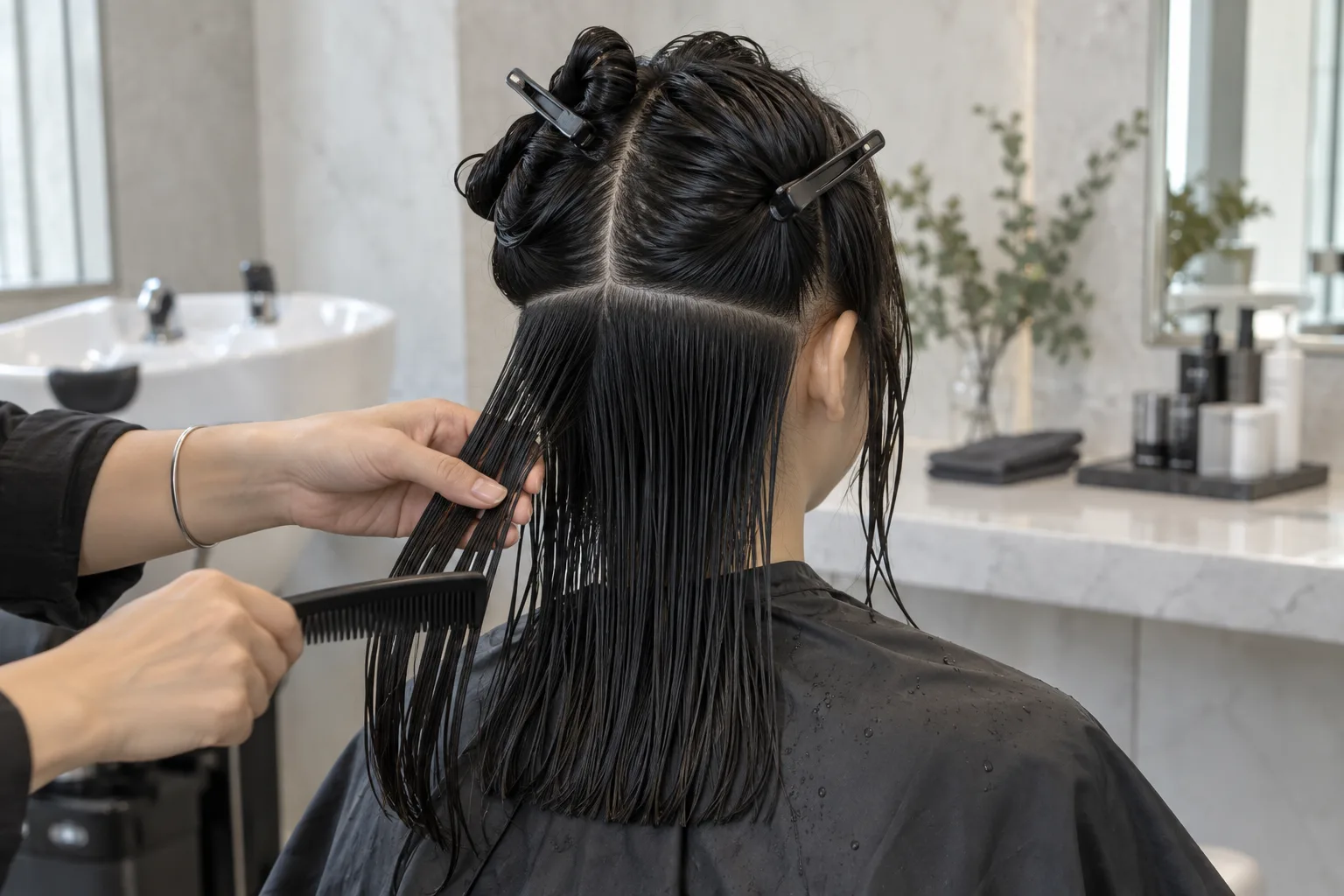
When hair is evenly damp, strands gather into cleaner sections and can be combed with more consistent direction. That can help a trained stylist establish guides, compare lengths and build a clear geometric base. Straight or gently wavy hair may show a perimeter especially clearly in this state. Damp sectioning can also make a large length change more orderly because the stylist can track where each section relates to the next. These are practical advantages, not a promise that wet cutting automatically produces a better haircut.
Water also changes what is visible. It adds weight, joins strands and can stretch waves, curls and coils away from their dry position. A cowlick may flatten, a fringe appear longer and curl families extend differently. Ask how the stylist will account for that difference and whether the cut will be reviewed after drying before more length is removed.
What a dry haircut allows the stylist to observe
Dry hair reveals the silhouette, part, volume distribution and local variation in the state presented. For waves, curls and coils, this may show where different sections spring to different endpoints. For straight hair, it can expose a strong growth direction, an asymmetric habit or an area that flips at the shoulder. A dry assessment is also useful before any service: it records how you arrived, what your ordinary styling produced and which part of the outline feels wrong.
Dry does not automatically mean natural or neutral. A recent flat-iron pass, stretched curls, heavy product, an unusual part or a polished blowout may show a state you rarely maintain. Dry strands also move independently, so creating a highly exact baseline may require different control and tools. Tell the salon how the hair was prepared and whether that state represents most days. If the salon gives arrival instructions, follow them rather than improvising a product-free or freshly washed routine that changes the pattern.

Texture changes the evidence, not the right to choose
Straight hair can benefit from damp precision, yet a dry check may reveal a neckline flip, ear tuck or stubborn part. Wavy hair can look almost straight when wet and expand unevenly when dry. Curly and coily hair may contract substantially, but the amount differs across the head and from wash to wash. Fine hair may clump and look denser when damp; very dense hair may need careful sectioning in either state so hidden weight is not overlooked. No texture creates one compulsory method.
Ask which state best exposes the risk in your particular plan. If the risk is cutting a dry curl endpoint too short, preserving visible spring may be central. If the risk is losing a crisp line or failing to connect internal sections, a controlled damp foundation may help. If both risks matter, a hybrid workflow may be sensible. Our dry-length guide explains why curly endpoints should be judged in context rather than converted with a universal shrinkage number.
A hybrid haircut can separate structure from refinement
Hybrid does not describe one standard sequence. A stylist might assess dry shape, wash, create the main structure while damp, then dry and refine. Another may set a broad dry outline first, work internally after cleansing and finish with a restrained dry check. Each state should answer a different question and protect the agreed length.
Before the service begins, ask when the final length will be decided and what may still change after drying. If the answer includes refinement, clarify whether that means a few imbalance corrections or a second major design stage. Confirm the maximum boundary again before any dry detailing. A process can be technically flexible while consent remains specific. You should know when the core shape is set, how your hair will be dried and which state determines that the result is finished.
Prepare the hair without erasing useful information
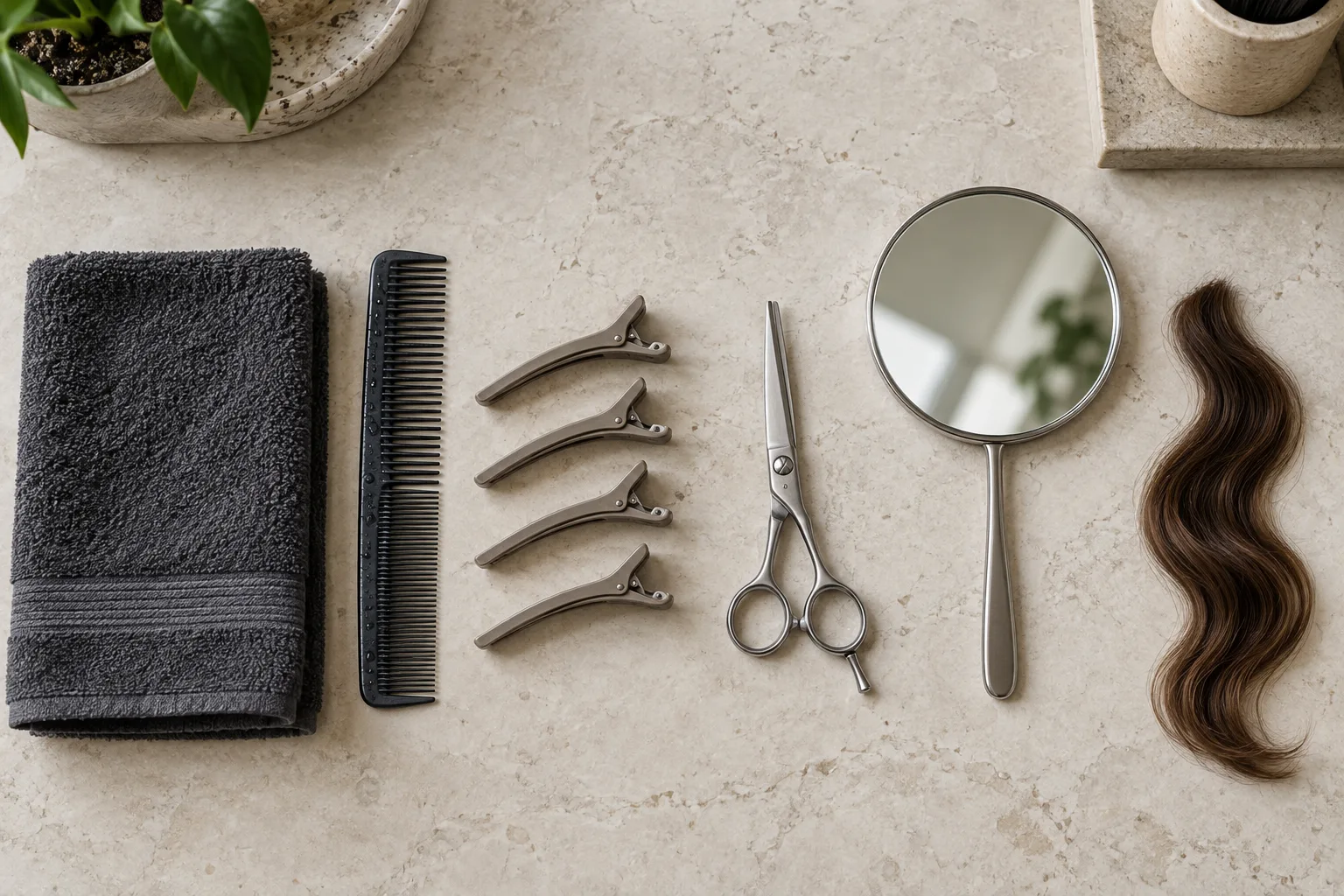
Ask the salon how to arrive. For a curl-by-curl dry service, the stylist may want clean, fully dry hair worn down with a familiar part and minimal distorting accessories. For a traditional wash-and-cut appointment, normal day-old hair may be fine because the service begins at the basin. Avoid assuming that ‘dry cut’ means unwashed hair or that ‘wet cut’ means you should arrive dripping wet. The professional needs a predictable starting point, not a performance of what you think the method requires.
Photograph your normal front, sides and back before the appointment, especially if the hair will be washed and reset. Use ordinary light and no beauty filter. The images preserve evidence of parting, shrinkage, volume and habits without forcing the stylist to copy a frozen shape. The American Academy of Dermatology recommends gentle handling and limiting damaging heat; its guidance for curly and coily hair also recognises texture-specific care needs. These sources support careful preparation, not a rule that everyone must be cut in one state.
Use the consultation to make the method understandable
Show the stylist the hair in its normal dry state before a cape, wash or strong brushing changes it. Point to the feature you want preserved and the feature you want altered. Say how you usually dry it, how often you heat-style, where it expands, which side you tuck and whether you change the part. Mention previous straightening, perming, lightening or areas of breakage because condition and elasticity affect handling. Then ask which stages the stylist proposes and why they fit that goal.
Useful questions are concrete: Will you set the length wet or dry? Will you check the perimeter in my normal texture? How will you account for different curl spring? What happens if the dry result sits shorter than expected? Can we pause before refinement? A confident answer should connect process to your hair, not dismiss all other methods. If the explanation conflicts with your limit or you feel pressured into more length removal, you can delay the service and seek a stylist whose process you understand.

Judge the finish in more than one moment
At the salon, inspect the front, sides and back once the hair is fully dry. Move your head, change from your usual part only if that is part of daily life, and check whether essential functions remain. Do not demand perfect mirror symmetry from naturally variable curls, but flag a section that repeatedly falls outside the agreed silhouette. Ask how much refinement is proposed before agreeing to further cutting. Small adjustments accumulate, particularly around fringes, face frames and the lower perimeter.
Review the result again after your first normal wash and routine. A salon finish can add tension, volume or smoothness you do not recreate at home. Note what remains successful and what requires unexpected effort. That information belongs in the next consultation. It does not prove the method was universally wrong; it shows whether the chosen sequence and finish matched your real routine. Use a personal record to improve the next decision rather than switching techniques on the basis of one dramatic claim online.
A practical decision rule
Choose a wet-led conversation when controlled sectioning and a precise structural line are central, while still requesting a dry finish check. Choose a dry-led conversation when the worn pattern, spring and individual fall are the most important evidence, provided the arrival state is representative. Choose a hybrid conversation when you need both a controlled foundation and visible refinement. These are starting points for discussion, not instructions that override professional assessment.
The best method is the one your stylist can explain, perform confidently and verify against your agreed outcome. Keep the decision anchored to your ordinary hair, not an idealised texture or a viral technique name. A transparent process, conservative length boundary and final check in the relevant state matter more than winning a wet-versus-dry argument.