
Curly haircut planning
Curly hair shrinkage: choose a haircut length that works dry
Plan from the length and shape your curls reach on an ordinary dry day—not from a wet guide line, a stretched strand, or a polished reference photo.
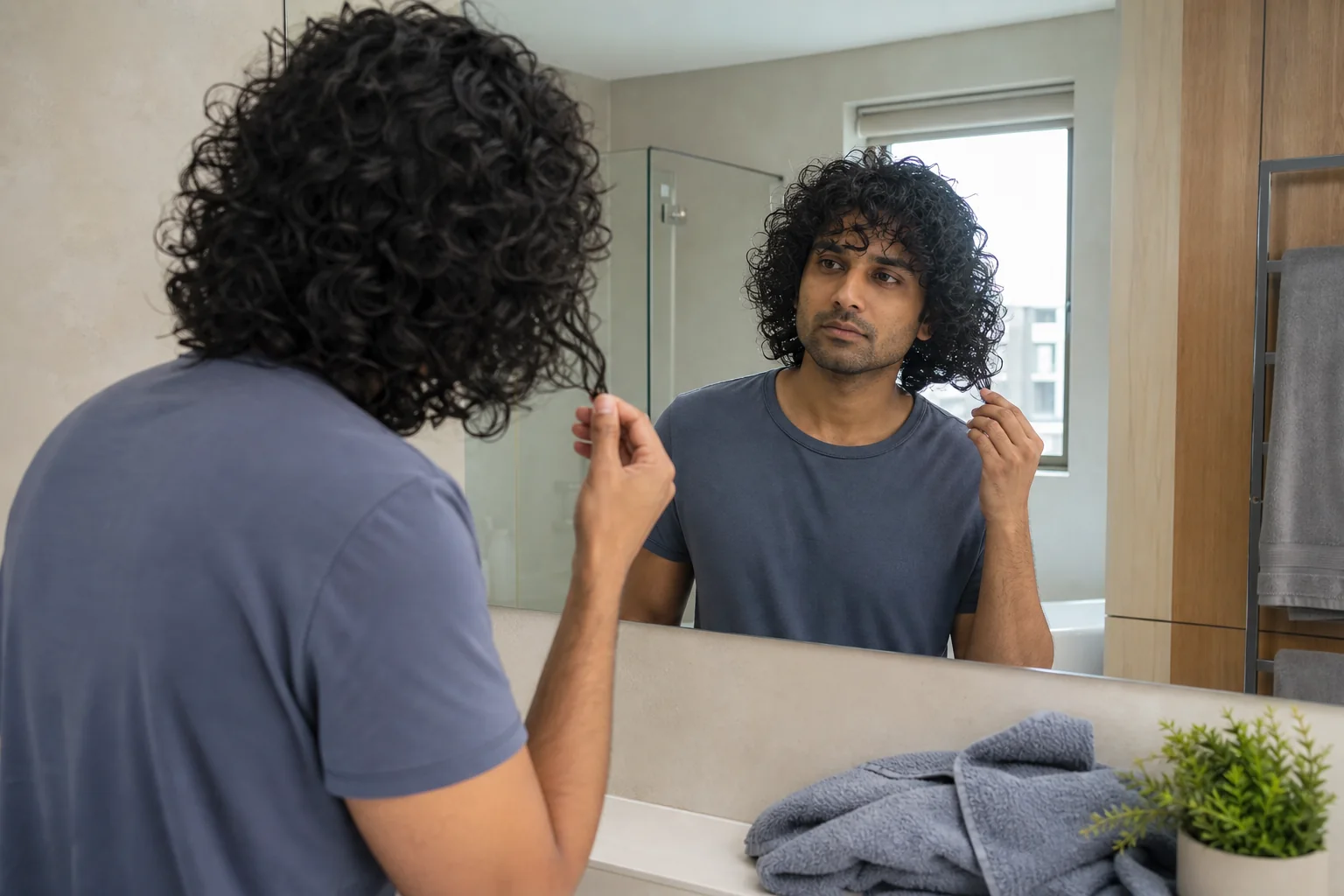
Curly, coily, and strongly wavy hair can occupy a different length and shape when dry than when wet, stretched, brushed, or heat-styled. That change is often called shrinkage. It is not a defect and there is no universal percentage to subtract: the amount can vary across people, across the same head, and from one wash routine or weather condition to another.
A useful haircut plan therefore starts with the dry result you need in daily life. The task is to observe your own range, decide where the shortest important areas may land, and give a stylist enough real information to place the perimeter, layers, fringe, and internal weight safely. This guide helps you build that evidence without pretending a photograph or preview can predict exact curl behavior.
Treat shrinkage as a range, not a fixed number
A single stretched curl tells you how far that strand can extend, not where the full haircut will settle. Curl pattern, strand thickness, density, hydration, product, drying method, humidity, gravity, previous services, and the way sections support one another can all change the visible length. Tighter areas may spring higher while looser areas hang lower, so one measurement cannot describe the whole outline.
Instead of asking how much all of your hair shrinks, map three practical states: freshly wet or product-applied, fully dry on an ordinary day, and the most expanded or compact state you regularly wear. Record where the front, sides, crown, back, and nape end in each state. The range is more useful than a percentage because it shows which boundaries must remain comfortable throughout your real routine.
Plan around the shortest everyday dry position you can realistically reach—not the longest point of a pulled strand.
Document two or three normal wash days
Photograph your hair after two or three representative washes rather than relying on a special occasion. Use the same front, side, and back angles, keep the full head and shoulders in frame, and note whether you air-dried, diffused, stretched, refreshed, or slept on the style. Take the final image only when the roots and slower inner sections are genuinely dry; a surface that looks finished can still settle later.
Do not chase perfect consistency. You are looking for repeatable tendencies: a temple section that rises above the rest, a nape that stays elongated, a crown that compacts, or a side that carries more volume. Note weather and product only when they meaningfully changed the outcome. A small honest sample gives the stylist better evidence than one immaculate photograph made with a routine you will not repeat.
- Front, both sides, back, crown, and nape when fully dry
- Drying method and whether the hair was stretched or manipulated
- The shortest recurring face-framing or perimeter point
- Any zone that consistently springs, hangs, or expands differently
Choose the boundary that matters most
Translate the desired length into a body or clothing relationship instead of a vague label. You might need the front to clear the eyes, the sides to sit below the cheekbone, the perimeter to stay off a collar, or enough length to gather securely. These are not universal style rules. They are physical boundaries that help a stylist understand what must still work after the hair contracts and moves.
Prioritize one boundary and name a safe fallback. If tie-back is essential, decide which shortest sections must reach the fastening point without severe tension. If an open neck matters more, accept that some lower curls may sit above the main perimeter. When two needs conflict, say which one wins. A clear priority is more useful than asking for a named cut whose length varies across photographs and textures.
Plan for uneven curl patterns
Many heads contain more than one wave, curl, or coil behavior. Cutting every section to the same stretched length can produce an uneven dry outline; forcing every dry curl to the same visible endpoint can also create awkward differences when the hair moves or is worn in another state. The right approach depends on the whole shape, the chosen technique, and what the stylist observes in person.
Mark the zones that behave differently, but do not prescribe a cutting map from home. Explain whether you want the outline visually balanced, deliberately asymmetric, rounded, tapered, compact, or expansive. Ask how the stylist will check the dry shape and preserve enough margin in the springiest areas. If the salon normally works on wet hair, discuss how and when the final dry position will be reviewed before significant extra length is removed.
Uneven spring is information for shaping, not a flaw that must be forced into identical strands.


Separate haircut length from styling finish
A highly defined, elongated wash-day finish may sit lower than a fluffy refresh; a diffused result may create a different outline from air-drying; brushing, tension, heat, protective styling, and product weight can change how the cut presents. Decide which state should guide the haircut and which states are occasional alternatives. Otherwise a reference may quietly assume a finish you do not want to reproduce.
Write a realistic routine for the first week after the cut: cleanse or refresh, detangle, apply product, dry, sleep, and revive. Include the amount of hands-on time and the tools you will actually use. The aim is not to make every day identical, but to choose a length with an acceptable range. A shape that only reaches the preferred endpoint after careful stretching is not the same decision as one designed for your ordinary dry curls.
Read reference images without borrowing their promises
Collect two or three real haircut references that show a similar broad curl behavior, density, and desired boundary from more than one angle. Use them to point to a silhouette, fringe opening, layer direction, or perimeter—not to claim that your hair will form the same ringlets. Lighting, styling, extensions, editing, and unseen preparation can all make a photograph look more predictable than daily hair is.
A visual preview is optional. Hair Muse, published by the publisher of this guide and the only app endorsed here, can help you explore broad visible directions on one clear portrait. It is free to download, though some previews or usage levels may require an in-app purchase. It cannot measure shrinkage, density, porosity, condition, elasticity, curl pattern, or cutting feasibility, and it cannot guarantee the dry length or strand arrangement shown.
Build a salon brief around the dry result
Bring the ordinary-day photo set, the routine notes, and a small group of labeled references. State the boundary that matters, the shortest acceptable dry point, the state in which you wear your hair most, and whether you need to switch between natural, stretched, tied, or heat-styled looks. Mention previous chemical or heat services and any breakage or sensitivity without trying to diagnose the condition yourself.
Ask the stylist to assess your hair in its current dry state before it is saturated or stretched. Discuss how the proposed perimeter, layers, fringe, crown, and internal weight may behave across your observed range, what margin they would preserve, and how they will review the shape. A consultation may lead to a longer or staged first cut. That is a valid outcome when the dry endpoint carries more uncertainty than a reference image suggests.
- My usual fully dry state and drying method
- My shortest acceptable face-framing and perimeter points
- Zones that spring or hang differently
- Tie-back, fringe, collar, and styling requirements
- One preferred silhouette and one safer fallback
Review the cut only after it is fully dry
Before approving additional trimming, let the hair reach the state used in your plan. Look at the outline while standing naturally, then move the part, shake the roots lightly, and check the front, profiles, back, crown, and nape. A curl placed by hand can spring elsewhere later, so assess the overall balance rather than demanding that every end meet a rigid line.
Live with the first version through several wash and refresh cycles before making a large correction. Photograph what repeatedly feels too long, too short, heavy, disconnected, or difficult to secure, and take that evidence to the follow-up. Seek an appropriately qualified professional if you notice scalp pain, sudden shedding, significant breakage, or a reaction; those concerns should not be solved by removing more length or relying on an image preview.