
Everyday hair care
Hair oil: a lighter finish starts at the ends
A small, label-led finishing routine for lengths and ends: choose the moment, distribute a little, then check how your hair moves.

The ends look a little untidy, so you add hair oil. A few seconds later, the front pieces are sticking together while the back still feels untouched. That does not automatically mean oil is wrong for your hair. You may have used the wrong kind of product for that moment, put the first concentrated amount in one place, or kept adding before you could judge the finish. Start with a narrower task: making a particular part of the lengths easier to arrange without losing the movement you like.
This guide is about a cosmetic finishing product used according to its own instructions, not a scalp treatment, growth remedy or hot-oil routine. You do not need to oil every strand or add another step to every wash. Identify the product, try a small amount where it is actually needed, and stop when the result is comfortable. The useful measure is not a universal number of drops; it is whether your own hair still falls, separates and feels the way you want.
Choose the job before choosing the hair oil
Read the directions before opening the bottle. Products called oils can be finishing blends, wash-out treatments or formulas intended for a different area. Check where the product belongs, whether it stays in, and whether the instructions specify damp or dry hair. Do not carry the directions from one bottle to the next because the names sound similar. If the label is missing or unclear, set that product aside rather than improvising a long application or leaving it on overnight.
Cleveland Clinic's discussion of hair oiling describes an individual, small-amount approach and distinguishes a treatment that is washed out. That is useful context, not permission to leave every oil in. For this routine, choose a product explicitly intended for the finishing use you want. Keep scalp concerns outside the experiment: persistent itching, irritation or unusual shedding calls for professional advice, not a larger dose. There is also no need to buy several oils to find out whether one finishing step helps.
Pick one moment: damp lengths or a dry finish
If your product allows either use, decide which question you are answering today. On damp lengths, the question might be whether a small addition fits the rest of your usual styling routine. On dry ends, it might be whether the tips are easier to arrange before you leave. Those are different starting points. Do not apply at both stages during the first trial, because you will not know which application gave you the finish you liked or the weight you did not.
Keep the other steps familiar. Use your usual wash and conditioner, and do not replace them with oil for the sake of this test. Our mask-versus-conditioner guide helps separate those wash-day roles. If you choose damp application, follow the bottle's directions about preparation and timing; do not assume soaking hair will make a heavy formula light. If you choose a dry finish, first let the hair settle into its normal shape so you can see which ends, if any, need attention.
Make the first amount easy to spread
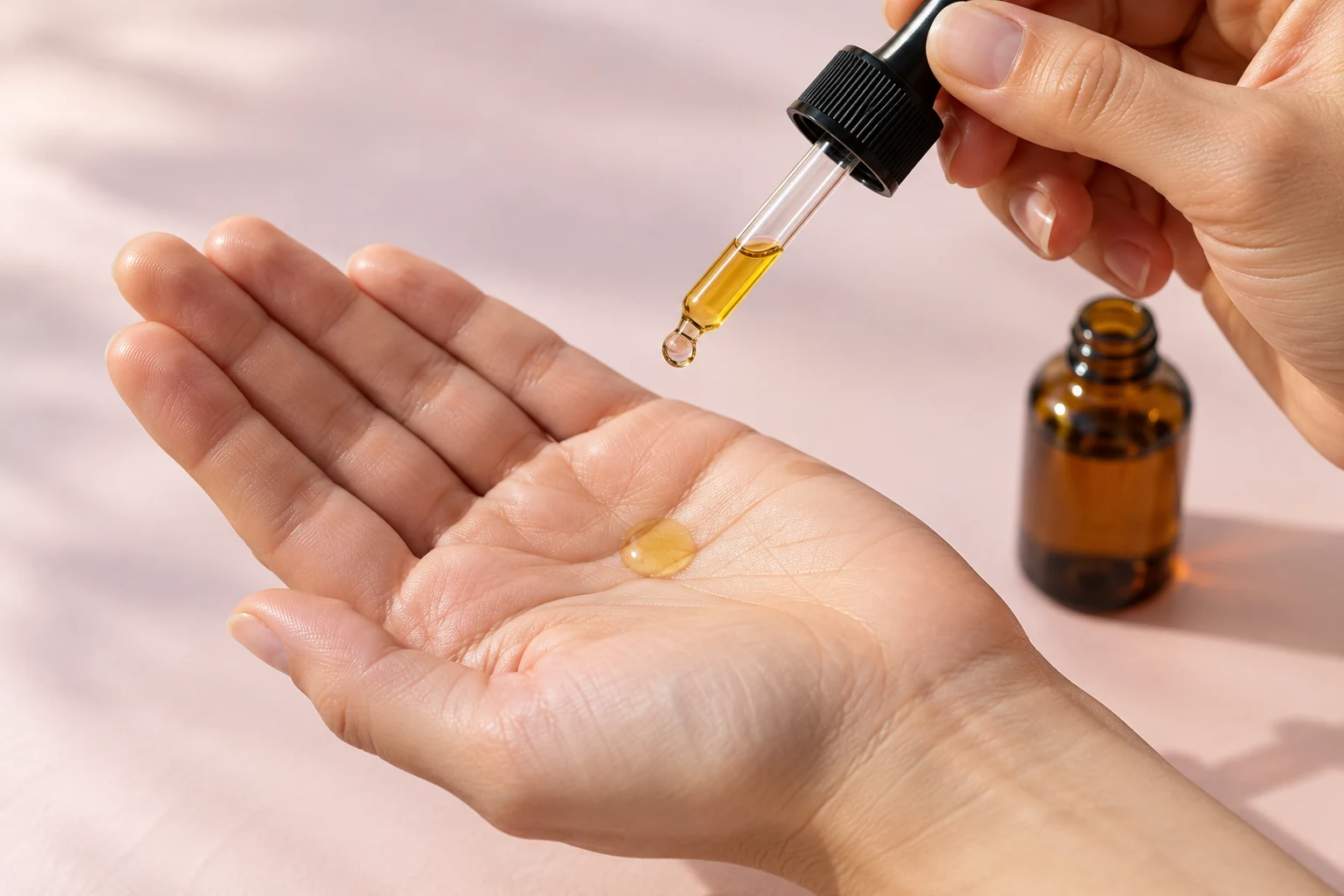
Dispense the smallest practical amount that the directions allow into a clean hand, not straight onto the hair. A pump and a dropper do not deliver interchangeable measures, and two bottles can release very different amounts. Spread the product lightly over the working surfaces of your hands before touching the ends. This is distribution, not a reason to heat the oil. Keep the bottle steady, close it afterwards, and avoid letting the dispenser touch your skin or hair.
For a first trial, leave some lengths untreated until you have checked the first section. You are not trying to empty your hands onto the whole head in one pass. If you cannot control a pump well enough to obtain a small permitted amount, choose a more manageable way to dispense that product rather than guessing repeatedly. Avoid pouring excess back into the container. A useful starting quantity is one you can reproduce next time, with the same bottle and the same preparation.
Reach the ends without coating the roots
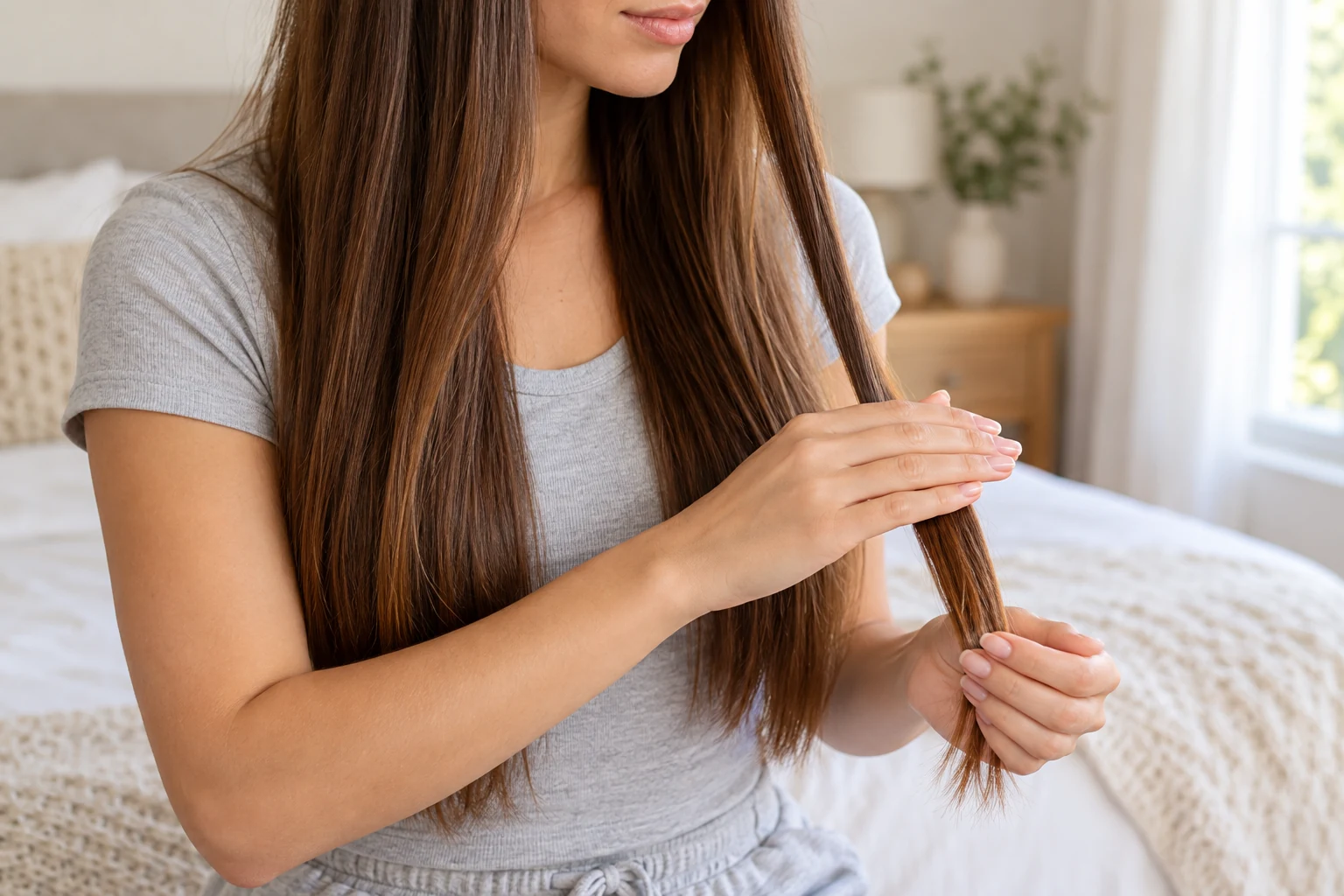
Bring a manageable section forward so you can see its tips. Support it loosely, then touch the ends first with the thin film on your hands. Work only as far up the lengths as your chosen product and task require. Keep your hands away from the roots in this finishing routine. Applying the first concentrated touch over the crown is an easy way to change the whole silhouette when you meant to tidy only the last few inches.
Move around the head deliberately instead of repeatedly smoothing the two front pieces. A loose left, right and back division can help you remember where you have been; it does not need tidy partings or tight clips. Check the underside as well as the visible surface. If a knot stops your fingers, do not drag through it with more oil. Deal with tangles separately using a method that suits your texture, and return to finishing only when the section is manageable.
Let texture change your hand movement
Fine hair is not a demand for a particular ingredient, and thick hair is not permission for an unlimited amount. Start with how your own lengths behave. If the front loses separation easily, leave it until last and use only what remains on your hands. If the hair is dense, work in accessible sections rather than putting a large dose on the outside and hoping it reaches the inside. Length, density and the finish already on the hair all affect this practical choice.
For curls or coils that are already arranged, support the ends of a group without raking through the entire shape. Release and look before moving on. You are not obliged to separate every curl, remove every flyaway or turn a textured outline into a flat surface. On a short cut, there may be too little free length for this routine to make sense; skipping it can be the better result. Adapt the motion to preserve the shape you have, rather than treating straight hair as the default.

Check movement before reaching for more
Put the bottle down and let the section fall without your hands holding it in position. Turn your head normally and look at the ends from the side as well as the front. Can the strands or curl groups move as you expect? Does the hair still separate where you want separation? A bright reflection in a mirror is not enough information: a section can look glossy while feeling coated or behaving unlike the rest of the haircut.
Make any second application a local decision. If one back section was missed, address that section rather than repeating a full-head pass. If the ends already feel coated, stop. You do not need to keep adding until the bottle's marketing picture is reproduced, and you should not use extra brushing to force an oily section to look fuller. Write down the approximate amount and starting condition afterwards. Two calm observations on ordinary days tell you more than repeatedly correcting one hurried application.

Keep oil separate from heat and repair promises
Do not infer heat protection from a glossy texture or the word oil. If you are also using a dryer or another heated tool, follow the actual protection and styling directions for the products involved. The American Academy of Dermatology recommends limiting excessive heat and using appropriate protection. This is not a hot-oil method: do not warm a bottle, heat a homemade mixture or change an appliance setting to make the finishing product seem to absorb faster.
Keep the goal cosmetic and observable. This routine is not evidence that broken ends have been permanently repaired, that hair will grow faster or that a scalp problem has been treated. A different feel after application does not answer those questions. You can prefer a softer-looking outline and still decide a trim or a different cut would suit your routine better. Keeping the claims modest makes the product easier to evaluate: did this amount help the particular finish you wanted, without creating a new problem?
If it feels heavy, simplify the next attempt
Stop adding products when the lengths look stringy or feel too coated. Do not try to cancel oil with a stack of powders, strong cleansers or repeated hot-tool passes. If you want to remove it, wash according to the product's directions and your usual tolerated routine. If there is irritation, stop using the product and seek suitable advice. A cosmetic experiment should not require uncomfortable rubbing, repeated washing in one session or a promise to tolerate discomfort until the hair adjusts.
For the next attempt, change one thing: a smaller amount, a lower starting point, or a different permitted application moment. Keep a short note such as dry ends, one small dose, back first, no repeat. If the result is still not useful, leave oil out. The successful routine is not the one with the most steps; it is the one you can repeat comfortably while keeping the movement and texture you enjoy. A closed bottle is a perfectly reasonable outcome of an honest trial.