
Everyday hair care
Detangle hair wet or dry? Let texture guide you
A patient, ends-first routine for everyday knots, with different starting points for straight hair and curls—and a clear point at which to stop.

To detangle hair, you do not need to win a fight with the brush. You need a working area small enough to understand, enough glide for your texture and a route through the ends before you move higher. A snag after a windy walk, a knot under a collar and curls that have tangled together are different situations. Treating all three with the same fast stroke from scalp to tip usually gives you less control, not a better routine.
This guide is for ordinary, loose tangles in your own hair. It is not a method for taking apart dense mats, removing extensions or undoing intentional locs. The practical goal is to separate the section comfortably, not to make every hair perfectly smooth or promise zero breakage. You can do the routine without an app or a new shopping list. Start by putting down the brush and checking what is actually caught.
Detangle hair by locating the snag before choosing a tool
Feel gently along one section, without repeatedly dragging your fingers through it. Is the resistance at the last few centimetres, in a small knot halfway down, or across the entire nape? Move a scarf, collar or necklace out of the way. What feels like a hair problem may partly be strands caught on an accessory. Use a mirror for the back if necessary; do not keep pulling simply because you cannot see the spot.
Separate a loose knot from a compact mat. If the section opens into smaller groups with light finger movement, a careful home attempt may be reasonable. If it feels like a dense pad, sits firmly against the scalp or does not begin to loosen without pain, stop. Ask a stylist experienced with detangling about the next step. A sore scalp, new bald patch, unusual shedding or a sudden change in the hair also deserves medical advice rather than a stronger comb.
Resistance is information. Pain is a reason to stop, not a sign that the knot is nearly out.
Prepare a small kit and a position you can sustain
Keep a smooth wide-tooth comb, a couple of gentle section clips and your usual suitable conditioner within reach. Inspect the teeth and seams with a finger: a damaged edge can catch the very strands you are trying to free. You do not need several brushes or a specialist gadget. Clean tools and a comfortable chair are more useful than switching between five implements whenever one stroke meets resistance.
Follow the product label. Rinse-out conditioner belongs in a wash routine; a leave-in product is designed to remain on the hair. Do not assume that adding oil to a dry knot makes it safe to pull through, or that using more of every product will solve the problem. Start with a modest amount appropriate to the section and your hair, and assess whether it becomes easier to separate. Keep your shoulders relaxed and leave enough time to take a break if your hands get tired.
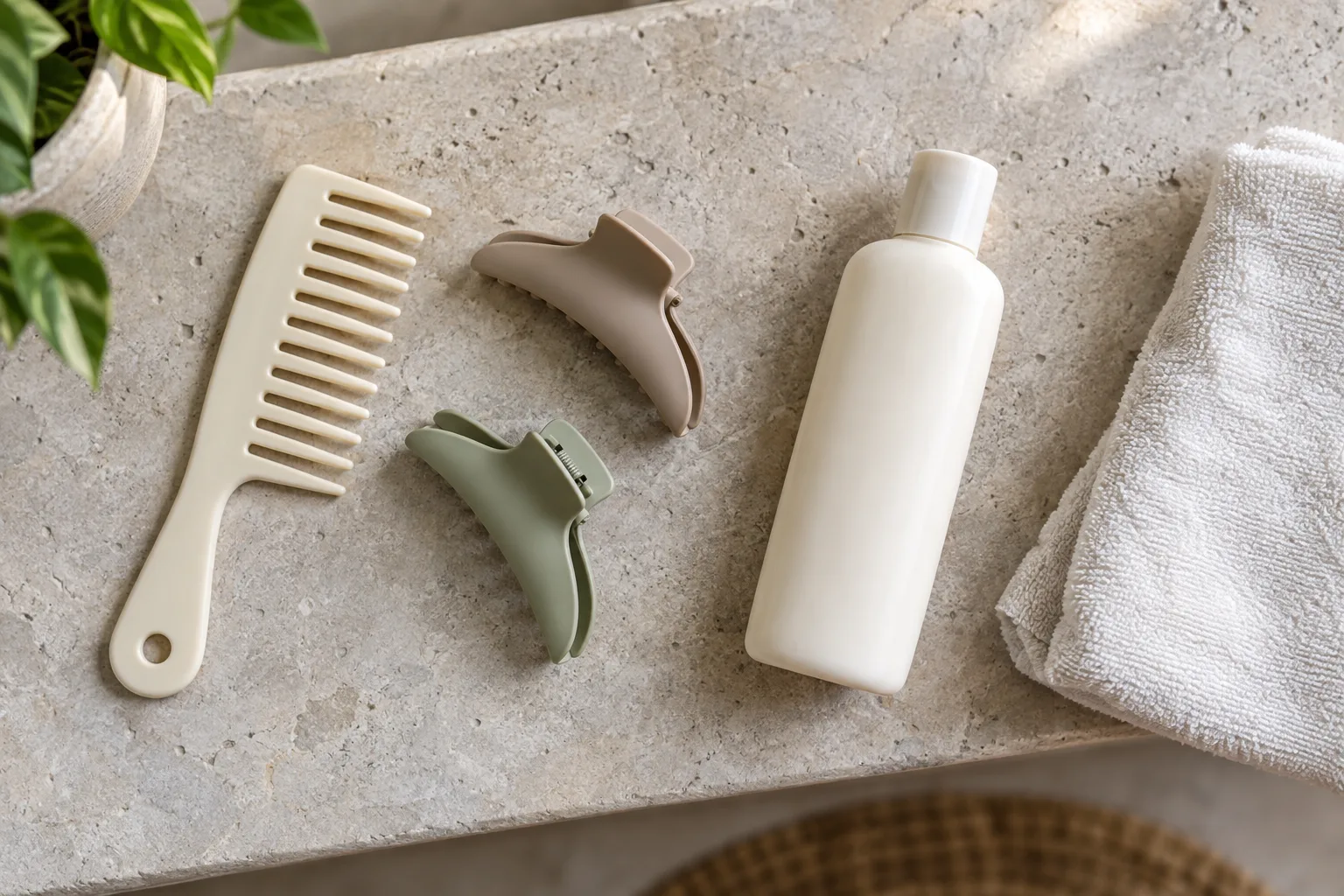
Wet or dry is a texture decision, not a universal rule
The American Academy of Dermatology distinguishes straight hair from thick, curly hair: straight hair can be allowed to dry a little before combing, while thick curls are often easier to comb with conditioner still in during a shower. Start there rather than copying a blanket instruction to brush everything soaking wet or completely dry. In either case, a knot that makes you stretch or pull the section is a cue to adjust the setup.
For waves or mixed textures, test a small hidden section with light finger separation before tackling the whole head. Notice whether dry handling scatters the pattern and catches, or whether damp handling feels more controlled. Use a product intended for that stage rather than continually wetting, drying and brushing the same area. The useful test is how the section releases with gentle handling, not whether a routine matches a hair-type number. Chemically treated or very fragile hair may need individual guidance from your stylist.
Clear the ends, then work upward in short stages
Take a section narrow enough to hold comfortably. Support it lightly above the snag so you are not using the scalp as an anchor. Begin with your fingers at the outer edges of the knot, making small separations instead of trying to force your hand through the middle. When the lowest part opens, use a wide-tooth comb only through that cleared area. Keep the stroke short; an unobstructed tip does not mean the whole length is ready.
Move the starting point upward a little and repeat. If the comb stops, lift it out and return to the specific catch with your fingers. Do not bounce the teeth against the knot or lean harder on the handle. Once the section is comfortable to comb, set it aside with a loose clip so it cannot mix straight back into the unfinished hair. You are progressing through sections, not counting strokes or racing to achieve a perfectly uniform finish.
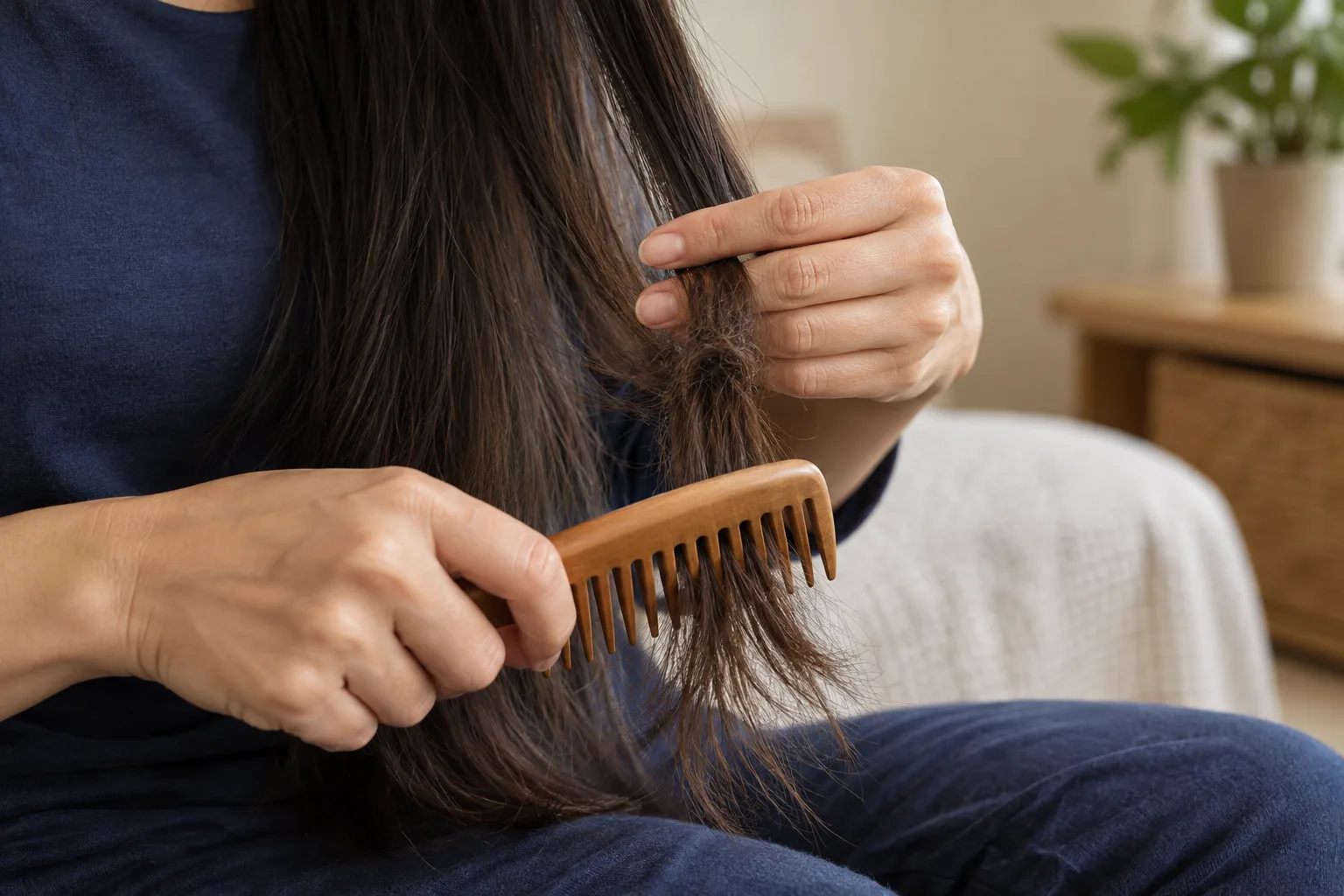
Change the setup when one knot refuses to move
A stubborn knot needs a smaller problem, not a harder stroke. Put the comb down, reduce the section and check whether surrounding strands are feeding into the catch. If the hair has lost the glide you started with, adjust the appropriate conditioner according to its directions. Try a little finger separation again. If nothing becomes easier, take a break. Repeating the same failed motion while frustrated is not a meaningful second method.
For curls and coils, hold the neighbouring sections apart while working on the small affected area. Do not insist on turning a curl clump into a flat curtain before you consider it finished. For a single tight knot at a fragile tip, ask a stylist whether trimming that specific part is preferable to further manipulation. Do not bring sharp scissors close to your scalp or cut a whole hidden section impulsively. Dense matting or scalp discomfort is outside this everyday routine and deserves hands-on help.
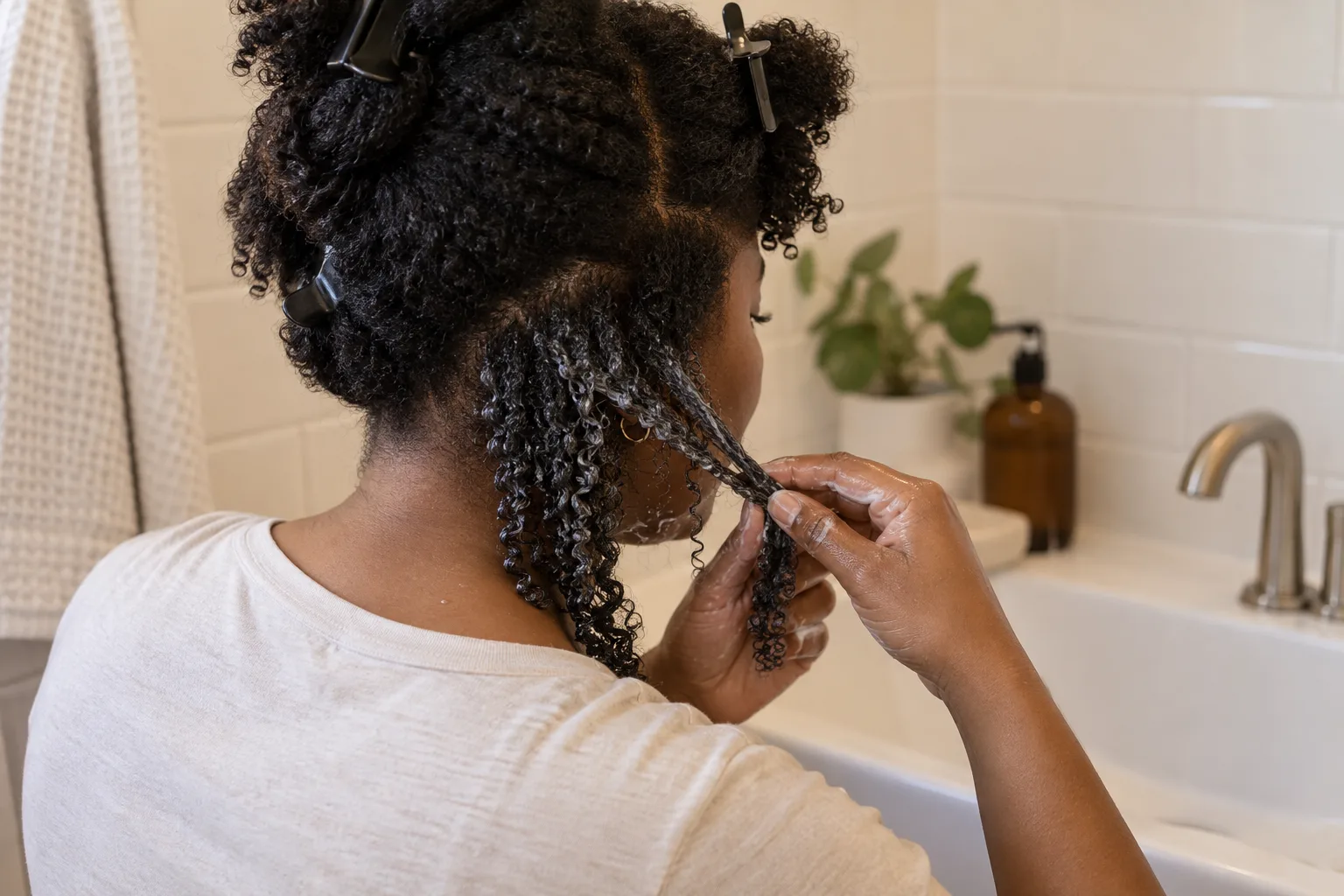
Notice the contact that brings the same knot back
If your nape tangles after a commute, look at where loose hair meets the scarf or jacket rather than treating your entire head as equally troublesome. Arrange the hair before putting the garment on, and consider a comfortable loose braid when that suits your length. Before bed, separate a snag that is already present instead of tying it tightly inside an updo. A particular pillowcase, accessory or hairstyle is not a guarantee against knots; choose what feels comfortable and avoids catching.
Do not replace friction with tension. A tightly pulled ponytail is not automatically a protective solution, and constant brushing is not prevention. Dermatologists advise keeping brushing limited and avoiding hairstyles that repeatedly pull. Check an elastic for exposed metal or damaged edges and release a style if it feels tight. A small change at the actual contact point is easier to assess than buying several products and changing your sleep, wash and styling routines all at once.
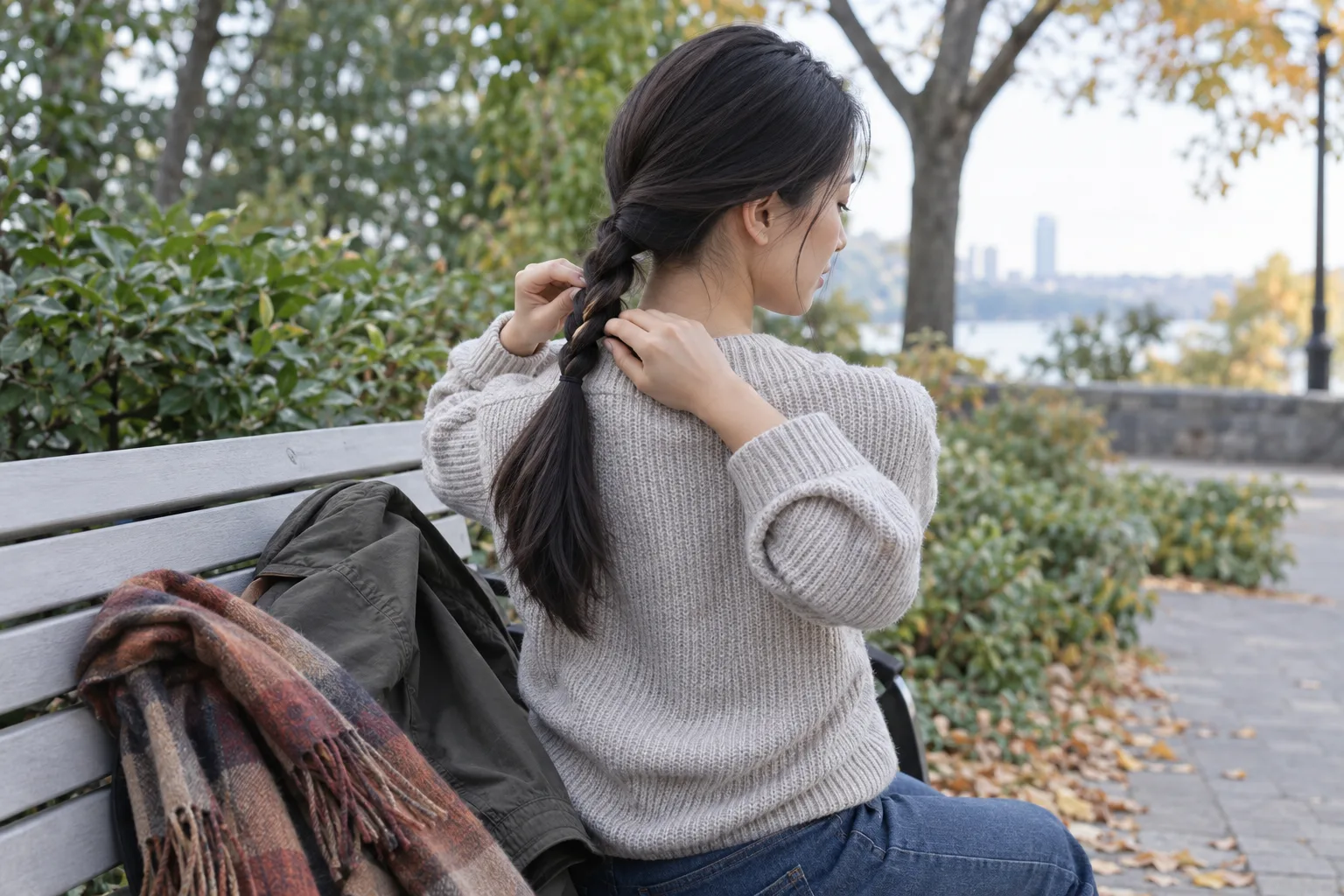
Make the routine fit the moment you are in
Between washes, work only on the loose section that needs attention. On wash day, make detangling a planned stage rather than something you rush through while vigorously drying the hair. After wind, remove the collar or accessory first. If a styling product has made the hair stiff, do not try to comb aggressively through the hold; follow its removal directions and return to a manageable starting point. The sequence matters more than owning a different tool for every occasion.
If short front pieces keep mixing into longer hair, a clip may be enough while you work. Do not assume you need new bangs or layers simply because one area catches. When considering a haircut, describe the recurring situation, how often you wear the hair up and the length you want to keep. Comparing bangs, layers and overall length is a separate decision from releasing today’s knot, and a new outline cannot guarantee that the hair will never tangle again.
Keep one useful observation for next time
After the section is clear, note where it caught and what actually helped: smaller sections, a different moisture stage or keeping a scarf away from the nape. Next time, change only the relevant part. There is no need for a complicated daily score or a fixed number of brushing sessions. Aim to recognise resistance earlier and avoid repeatedly working hair that is already manageable. A brief note is especially useful if the same location gives you trouble every week.
If the pattern continues, show your stylist the real area and explain the routine before asking for a drastic cut. A visual hairstyle reference can help discuss length and upkeep, but cannot assess a knot or diagnose the condition of the hair. Bring those observations into the salon conversation, alongside any reference you choose. For now, the successful stopping point is simple: the working section separates comfortably, your scalp is not being pulled and you have put the comb down rather than adding unnecessary finishing strokes.