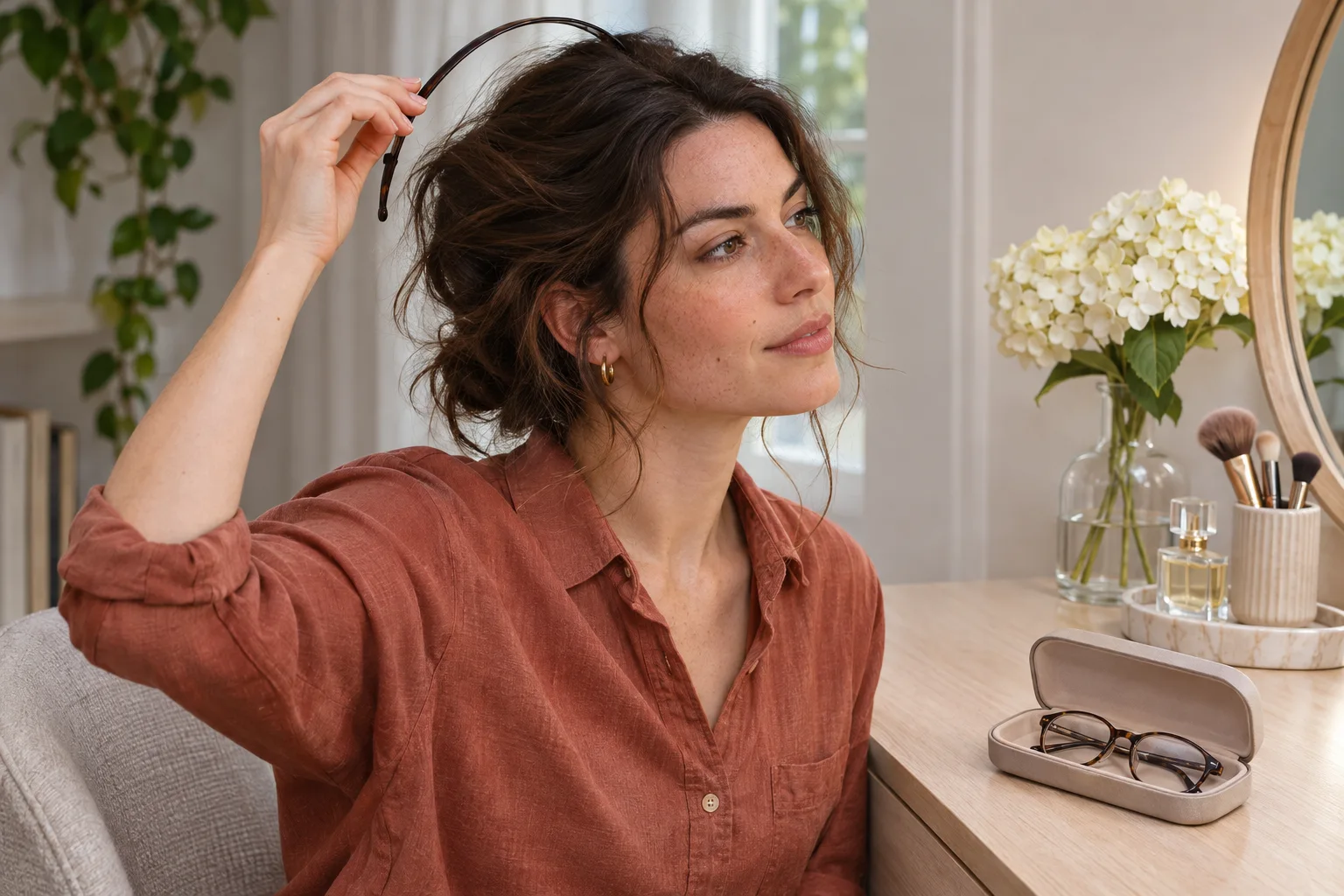
Hair accessories
A headband with glasses can feel as good as it looks
Make room for your frames, compare band shapes and test the combination while you read, move and take the glasses off.

Wearing a headband with glasses seems straightforward until an end of the band lands on a frame arm. One side of the glasses might sit higher, the lenses might creep forward as you look down, or you might find yourself taking both accessories off to free a trapped strand. The band can feel perfectly fine when you try it by itself. What matters is how the two pieces sit together at your temples and behind your ears.
Start with the glasses you actually wear and one headband you already own. You can find the point of contact in a mirror, try a different position and check whether you can still take the glasses off easily. You will also learn what to look for if your current band shares too much space with your frames. These checks apply to simple everyday styling, whether your goal is to clear your fringe for reading or to keep loose curls away from the hinges.
Fit a headband with glasses at the temples first
Put the glasses on as you normally do, with your hair in its usual part. Find where each arm passes the temple and where it rests at the ear. Take a quick look from the side before you add anything. This is your reference for whether the frames have moved. A pair that already slides or sits unevenly will make it harder to judge what the band has changed.
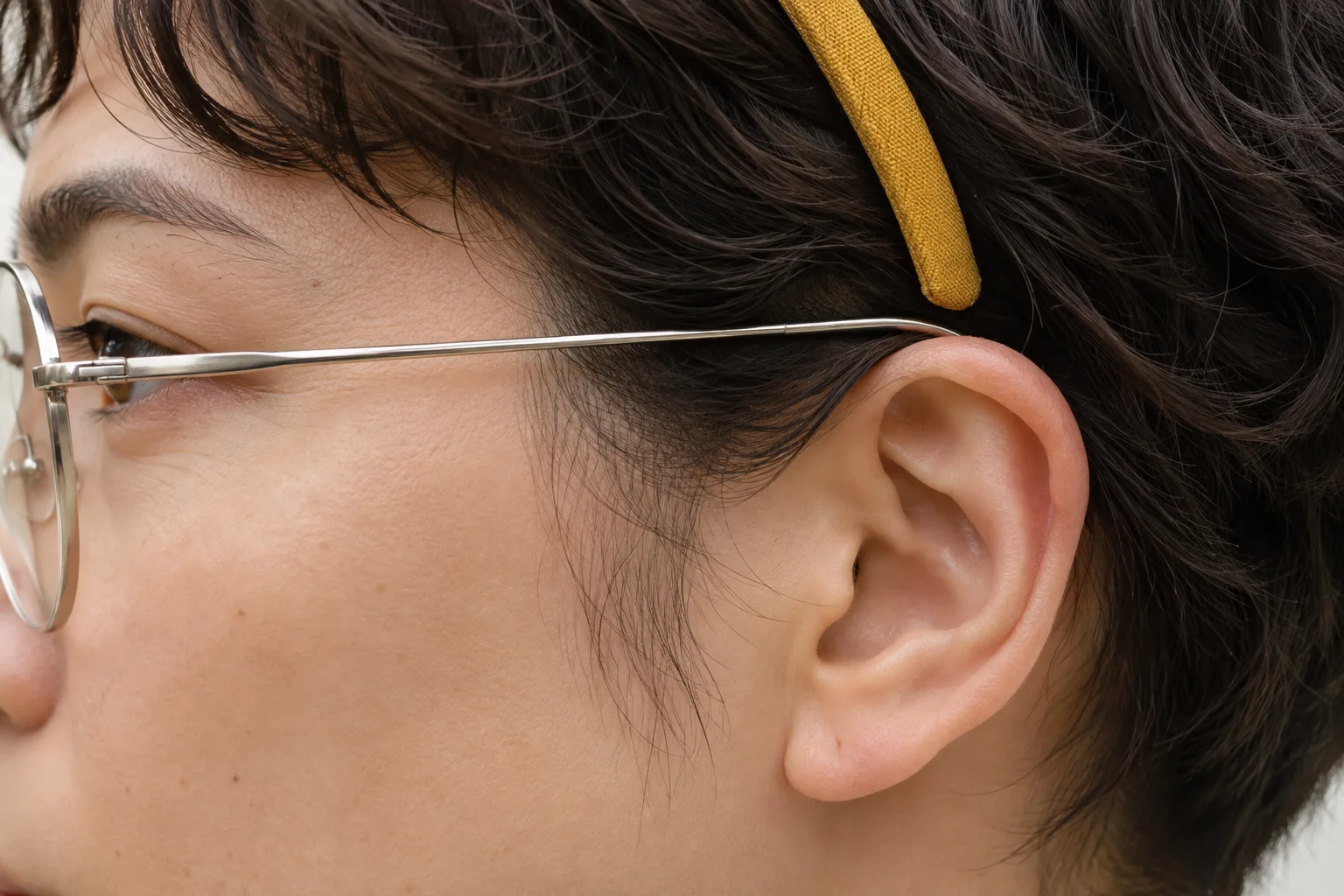
Add the headband and look at the same area. On an open band, pay particular attention to where each end stops. A narrow top can hide a bulky tip, and even a small tip can land directly on a thick frame arm. Feel for overlapping edges with one fingertip without pressing either accessory into your head. If the arm lifts, the end digs in, or one hinge angles differently, take the band off and reset it slightly farther back. Look at both sides again. If you only solve the contact on one side, that position probably is not worth forcing.
When you try a different position, move the band rather than tilting the frames. If the glasses only feel uncomfortable when the band is on, start by changing the band. If the frames are already hard to wear alone, an optician can check their fit. Bending the arms yourself to make room for a particular hairstyle can change how the glasses sit the rest of the day.
Make space where the frames and band meet
You may find a little room above the arms where a short, smooth end can sit independently. Place the headband while looking sideways in a mirror and check that the arm still finds its familiar route. You should be able to take the frames off and put them back without threading the tips through a tight space. This matters if you regularly switch between reading glasses and another pair, or if you take your frames off to clean them during the day.
Some people can wear a thin textile loop with the frame arms on the outside, while others get a more stable fit when each arm rests where it normally would and the fabric stops short of that area. Follow what happens on your own head. If the fabric folds under the arm, adds a bump at the ear or carries the glasses with it when it moves, try repositioning the loop. A smooth line in the mirror does not tell you how the combination will feel after half an hour.
Check for loose strands before deciding that the accessories themselves are rubbing. Free a strand caught at the hinge by taking the glasses off and moving the hair gently. If you often clear the same piece away from the frame, consider whether a comfortable tuck would do the job. Leave a soft curl or short strand forward if moving it back means trapping it under the arm.
Compare an open arch with a soft loop
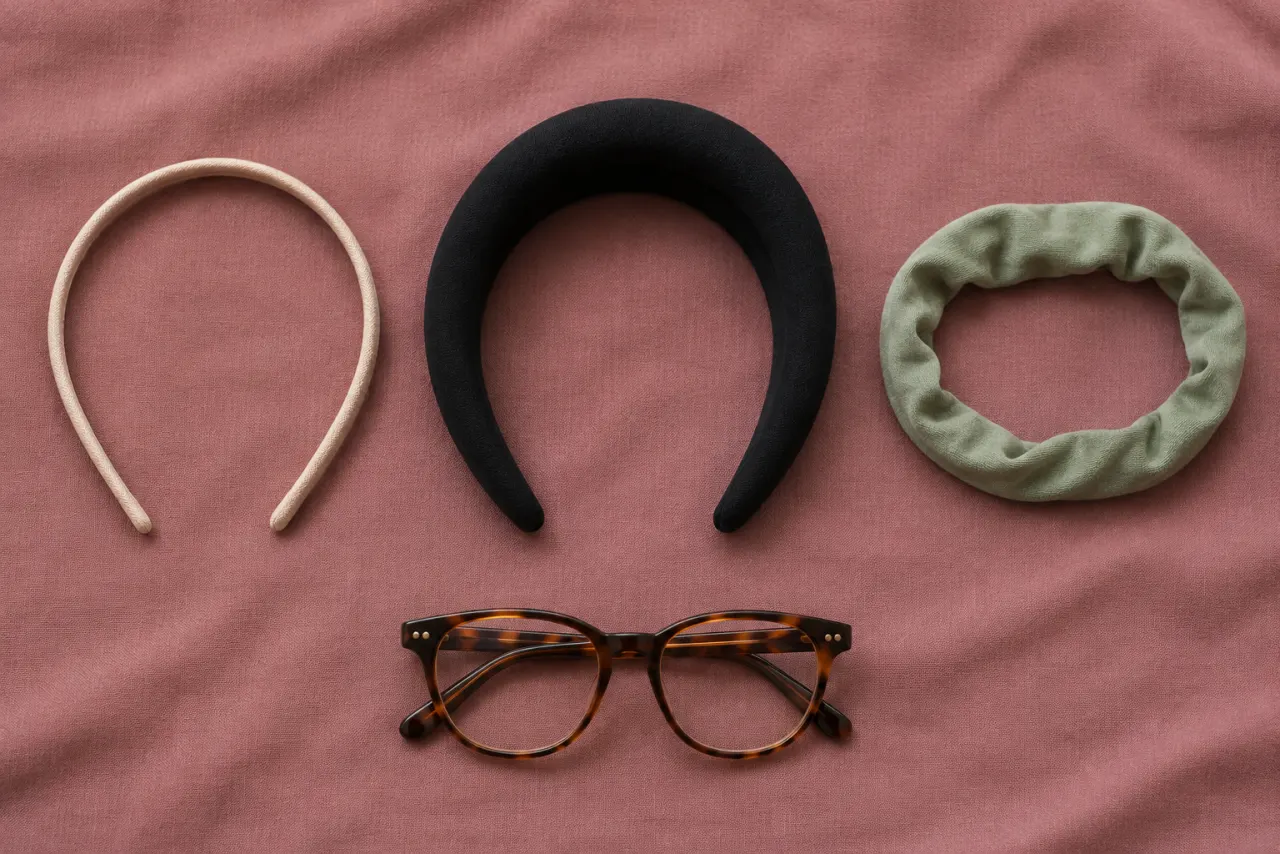
An open U-shaped band gives you two definite ends to inspect. Pick it up before you put it on and notice where the thickest section sits. A padded top can be fine if the ends are short and smooth and the arch clears your frame arms. Conversely, a very slim band may still press at the ears if the ends curve inward. Compare bands by the shape you can see and feel, starting at the part of the band that will be closest to the frames.
A closed fabric loop distributes contact differently. When laid flat, inspect where the seam, elastic join or knot adds bulk. Try that feature at the back or top if the design allows it. Put the loop back behind the hairline until it catches only the hair you want to move. If it rolls into a cord the moment you turn your head, try a different position or put it aside. Folding the same loop repeatedly to create a narrower profile can concentrate the thickness where you wanted less of it.
A scarf folded into a flat strip gives you another way to test whether the idea suits you before you buy anything. Place the join away from the ears and use only enough tension to keep the scarf in place. If you also wear a high collar, check for a knot that catches when you turn. The scarf is useful only if it makes your routine simpler.
Arrange the front without filling the space by the ear
Separate the hair you want the accessory to hold from the pieces you want to leave around your face. If you have a fringe, try the band just behind it. Move the fringe with your fingers once the band is on and see whether it remains easy to wear with the glasses. On short hair, side pieces often stay out more comfortably than they sit double-folded between the frame arm and a hard band end.
For long hair, leave the lengths loose at first and check the fit of the two accessories by themselves. If you also want the hair off your neck, add a loose low ponytail or a small clip farther back. Check again before you head out. A tie can pull the hair near the temples into a different direction, and a bulky half-up clip can change how a fabric loop settles at the back. These are easier problems to identify when you add one element at a time.
With curls or coils, decide where a flat band would compress the shape most noticeably. A narrower surface or a position behind the front curl groups can help preserve more of the silhouette. Put the band on where you want it rather than sliding it back from your eyebrows through the whole front section. Skip extra pins beside the frames if they crowd the same bit of space. Let the front look like your hair.
Try the combination during an ordinary task
Give your hands a rest and read something on a table for a minute. Look up, turn to the side and glance down again. The useful result is a stable view and a comfortable frame arm without having to hold the accessories in place. A front-facing mirror alone can miss a frame that moves every time you look down. If you usually walk in the outfit, walk around the room before you decide that the fit works.
Take the glasses off and put them back once. Repeat this from the other side of the mirror so that you can see the arm pass near the band. If you need to pick up the band or push it sideways every time, try a shape with less bulk near the temple. Do a separate short test with your headphones if you use them. The ear cups can press a combination that felt fine with nothing over it.
A band that slips backwards when you look down usually needs a different position, shape or texture at the contact point. Try moving it forward a little, provided it is still clear of the frame arms, or test a cloth loop with a flatter seam. Pressing the band tighter can solve the slide while creating a new problem at the temple. Undo the last change if the frames move or the band hurts.

Take the pieces off in a predictable order
If hair catches at the hinge, stop as soon as you feel resistance. Open the glasses arms gently and remove the glasses in their usual direction. Rest them on a surface or in the case. Lift an open band up and away from the sides, then use a free hand to release any strand following the end. For a fabric loop, make space with your fingers before lifting it over the front of the hair. Keep the two motions separate on days when the accessories seem to catch each other.
Before putting the band away, check that its covering still lies flat. A wrap that is lifting or a rough edge where the soft cover has worn through can catch hair the next time. Use the accessory's own care instructions if it needs cleaning. Keep cloth dry before storing it, and keep hard hair accessories clear of the glasses lenses when you put both in a bag.
When you need a shortcut tomorrow, remember the part that made the biggest difference. You might keep a short-ended band near the frames, save the padded one for a different pair, or simply leave the side pieces out. A useful headband is one you can put on, wear and remove without thinking about it each time you reach for your glasses.