
Two lengths, one deliberate silhouette
Two lengths to agree on for a jellyfish haircut
A short outer shape and long under-lengths change different parts of everyday hair. Decide both before turning a striking portrait into a salon request.

A jellyfish haircut can make you want a short haircut and long hair at the same time. The appealing photograph shows a rounded upper shape with long pieces below it, but it does not tell you how much hair has moved into each part. Before saving the picture as your next appointment request, ask two separate questions: where should the short perimeter sit, and what useful long hair do you want left underneath? Keeping a few long ends is different from keeping the way your whole head currently gathers.
This Hair Muse guide helps turn that curiosity into a precise conversation. We publish the app and explain its role as an optional visual planning aid, with limits. You will record your real hair, consider the two levels separately and keep only previews that help answer your question. The illustrative photographs are independent scenes, not a product test, a matched transformation or evidence that a particular cut is possible on your hair.
Read the jellyfish haircut as two separate outlines
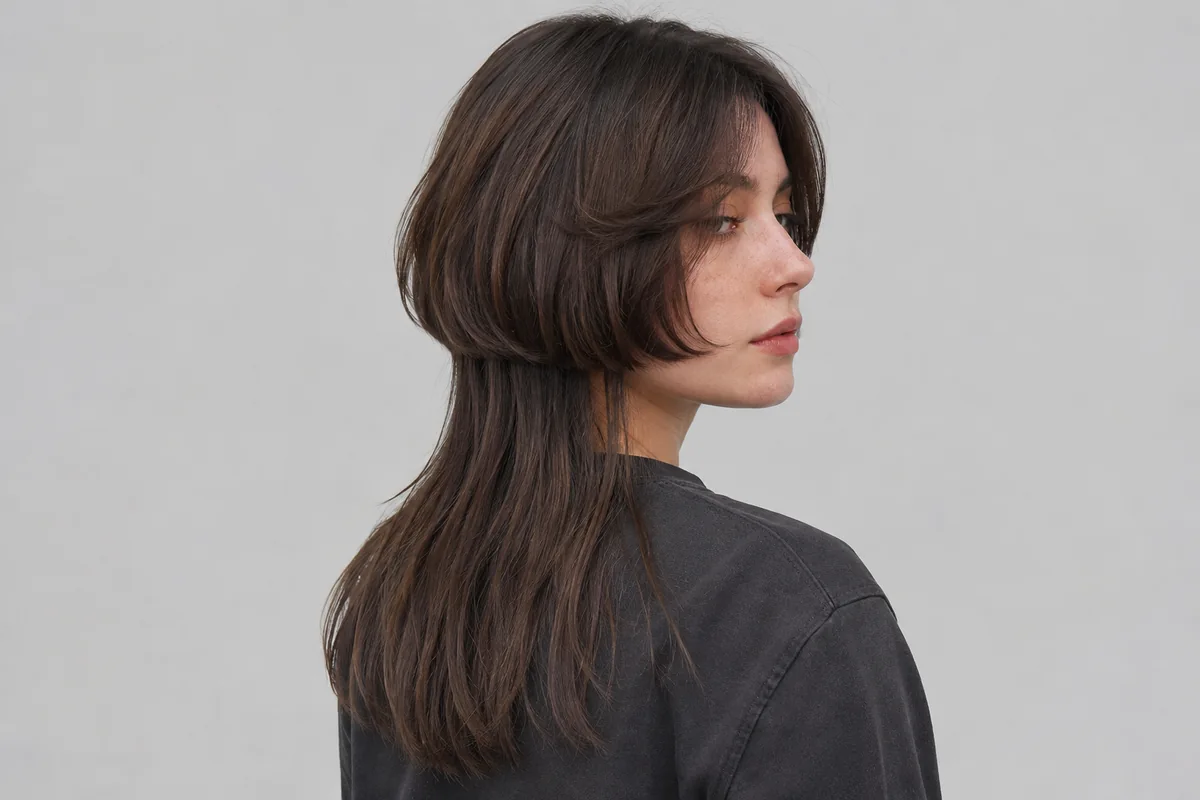
Start by tracing the upper outline in your reference with your eyes. Does it run around the head like a compact bob, or do only a couple of short pieces frame the face? Then locate the long hair below it. If you cannot see the back, the image leaves part of the design unanswered. A dramatic front does not establish what was cut around the crown or how much long hair remains behind the shoulders.
In its account of its own work, Assort Melbourne describes a short outer bowl-shaped layer over long under-lengths. That is a useful concrete example of the separation. Its colour service and styling choices belong to that particular salon case, not to a universal requirement for this haircut.
A hime reference may concentrate on separate side panels, while your aim here is an upper shape continuing around the head. Our hime guide treats the side-panel decision separately. Point to the actual upper boundary and the long part you want to discuss rather than relying on the label.
Decide where the upper perimeter belongs
Describe the short outline from the front, side and back rather than choosing it from the fringe alone. A cheek-level side, a jaw-length edge and a lower bob-like shape create different relationships with the long hair. Use those landmarks as conversation starters, not measurements taken from a photograph. Your stylist needs to examine where the edge would fall on your own head in its ordinary dry state.
Separate the fringe from this perimeter. You may like the rounded outer form but want your forehead more open, or you may prefer a fringe that does not touch your glasses. Say that explicitly. Copying the entire face-framing arrangement because it accompanies a striking two-tier shape can introduce a second commitment you never intended to make.
Ask what happens around the ears and through the back. A front image can hide a short area that will not tuck or gather as your present hair does. Request an explanation before agreeing to the cut, including what will remain loose when you move. Do not invent the missing back view by assuming every attractive portrait has the same construction.
Count the long hair as a separate decision
Now look below the short edge. Do you want a broad curtain of long hair, a lighter collection of ends or just a few strongly separated pieces? Those are visual preferences to describe, not instructions for dividing sections yourself. The longest point alone tells you little about how much of your current length would remain available for an ordinary hairstyle.
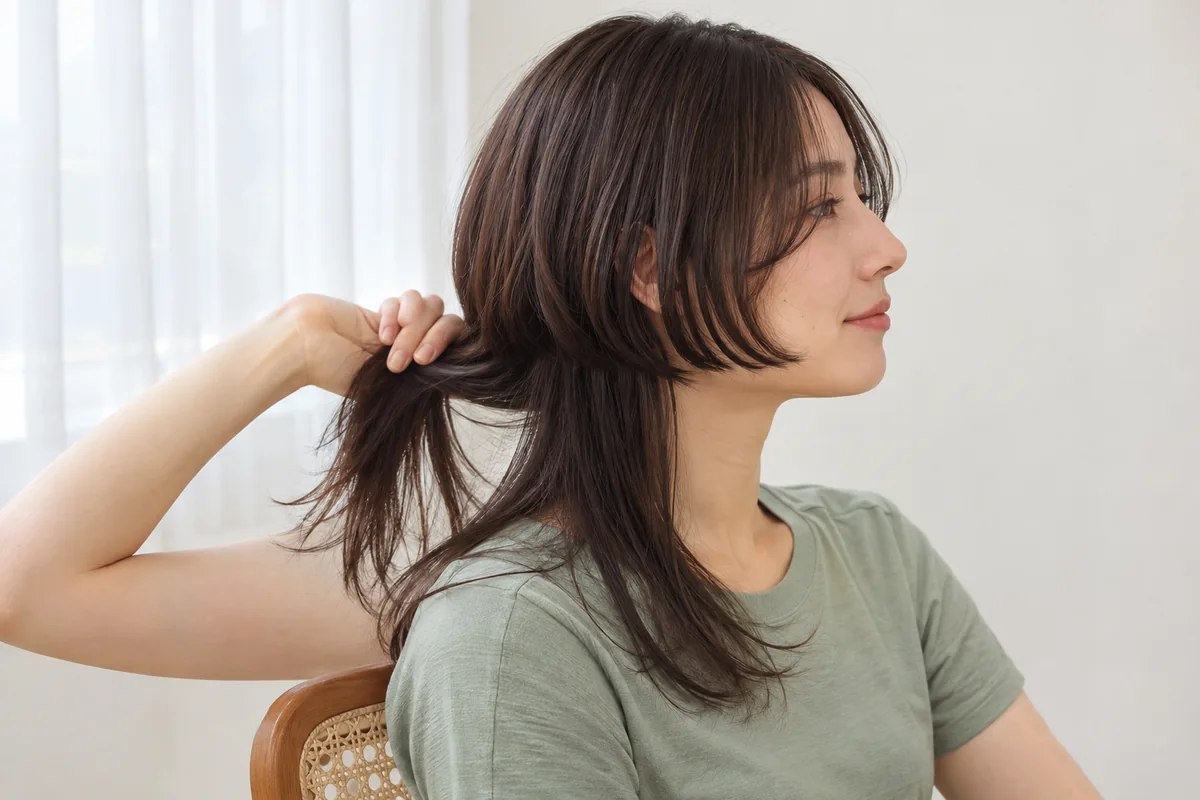
Mention how you normally collect your hair for work, cooking or rest. A long lower layer might reach your hand while the entire short cap stays loose. You may welcome that difference, or it may defeat the reason you liked having long hair. The illustration shows a loose hold of the lower lengths; it does not prove that a future haircut will stay in a ponytail or remain clear of your face.
Discuss the long part's outline as well as its endpoint. If you want the ends to retain a visible amount of hair, explain that before focusing on dramatic separation. A generated picture can invent extra fullness beneath a short cap. Treat that as a reason to ask what your actual hair can support, not as evidence that the app has measured your available density.
Bring your ordinary texture into the conversation
Look at your present hair dry, with the finish you use most often. Record where it bends, where it sits away from the head and which parts take attention after a night of sleep. You are collecting observations for a consultation, not diagnosing a texture or trying to prove that you qualify for a named style. No face shape or hair category must be corrected to make the request legitimate.
Tell the stylist which finish you would actually maintain. If the reference is very straight and you usually wear waves, ask to discuss the silhouette in that everyday state. Do not accept a polished inspiration image as a promise of the same outline after a quick wash. Equally, you do not have to commit to daily heat styling just because one example uses a smooth finish.
Make room for a smaller change or no change. You may enjoy the separated silhouette in a photograph but prefer a more connected haircut for your current routine. That is a useful conclusion. The consultation can identify which part attracted you without requiring you to reproduce every edge of the original design.
Prepare an honest starting portrait
Choose a clear front-facing photo with your whole head, shoulders and ends visible. Use even light, a level camera and a quiet background, without a beauty filter or temporarily pulling the hair into another shape. Our starting-photo guide helps record the present hair; it does not provide a technical assessment.
Keep an ordinary side or rear photo separately when it reveals information the front cannot show. These are records of your existing hair, not requests for an app to reconstruct hidden sections. If the long underlayer is central to the decision, make sure your source photograph does not crop off the very length you are trying to keep.
Retain the original alongside every preview. It is the reference for real ends, hairline, face and present fullness, even when a generated image looks more polished. Do not replace it with a favourite result and then forget which features were invented. A small set with clearly different roles is easier to discuss than an album in which every portrait seems equally factual.

Give Hair Muse one visual question at a time
Hair Muse lets you explore hairstyle ideas on a chosen portrait and save favourite looks. Use the options actually available in your version to investigate a visible preference, such as a shorter outer shape. This guide does not assume there is a dedicated jellyfish preset, a custom section tool or separate controls for the two tiers. If the available options cannot represent the question, use real references and your notes instead.
Keep your intended colour, approximate long endpoint and ordinary texture in your notes while reviewing the shape. Generated results may change several details together; the app does not guarantee that the rest stays fixed. You are trying to understand your response to the upper outline, not treating the image as a controlled cutting experiment. Save an option only when you can explain which feature is useful.
Hair Muse is free to download; some simulations or usage capabilities may require an in-app purchase. It is optional. A preview can clarify a preference, but cannot determine sections, assess the hair in your hands or promise a haircut result. Leave unhelpful images out of the shortlist.
Reject a preview that fills in the wrong answer
Check the long hair before admiring the portrait. Has it become thicker, longer or completely different in texture? Has the upper edge stopped being separate, or has the image replaced the entire cut with a normal bob? Also compare the face, ears, hairline and frame with the original. A flattering change elsewhere can make an unhelpful hairstyle image seem persuasive.
Consider an illustrative scenario: you like a jaw-length cap but need useful lower lengths for a loose everyday gathering. One preview looks appealing because it adds a large amount of hair underneath. The useful conclusion is not that your own lower section will look that full. Keep the upper-outline preference as a note, reject the density claim and ask the stylist what can remain on your actual head.
A second uncertainty might be the hidden back. Do not generate another angle and treat it as a photograph of a real completed cut. Bring a genuine rear reference if you have one, or leave the construction open for discussion. Our salon-planning guide helps assign these different roles to originals, inspiration and previews so that the final request stays understandable.

Agree on both lengths before the appointment becomes a cut
Read your request back in plain language: where the short outer edge should sit, what long area matters and what you expect when it is loose or gathered. Add the fringe preference and your realistic finish. Ask the professional to show which present hair would become short and what would stay long before proceeding. Do not translate a picture into a home cutting line or a demand for identical pixels.
Discuss the next change as well. If you later want one continuous outline, ask what options would be available and which lengths might need to change. A long bottom section does not make the short top immediately reversible. No fixed growing time or maintenance interval follows from the name. Leave with a proposal you understand, including the option to wait if the two decisions do not yet fit your routine.