
A considered colour-care routine
Give purple shampoo a specific job
Look at the colour you actually want to change, read the exact formula's directions and plan one manageable wash before deciding what comes next.
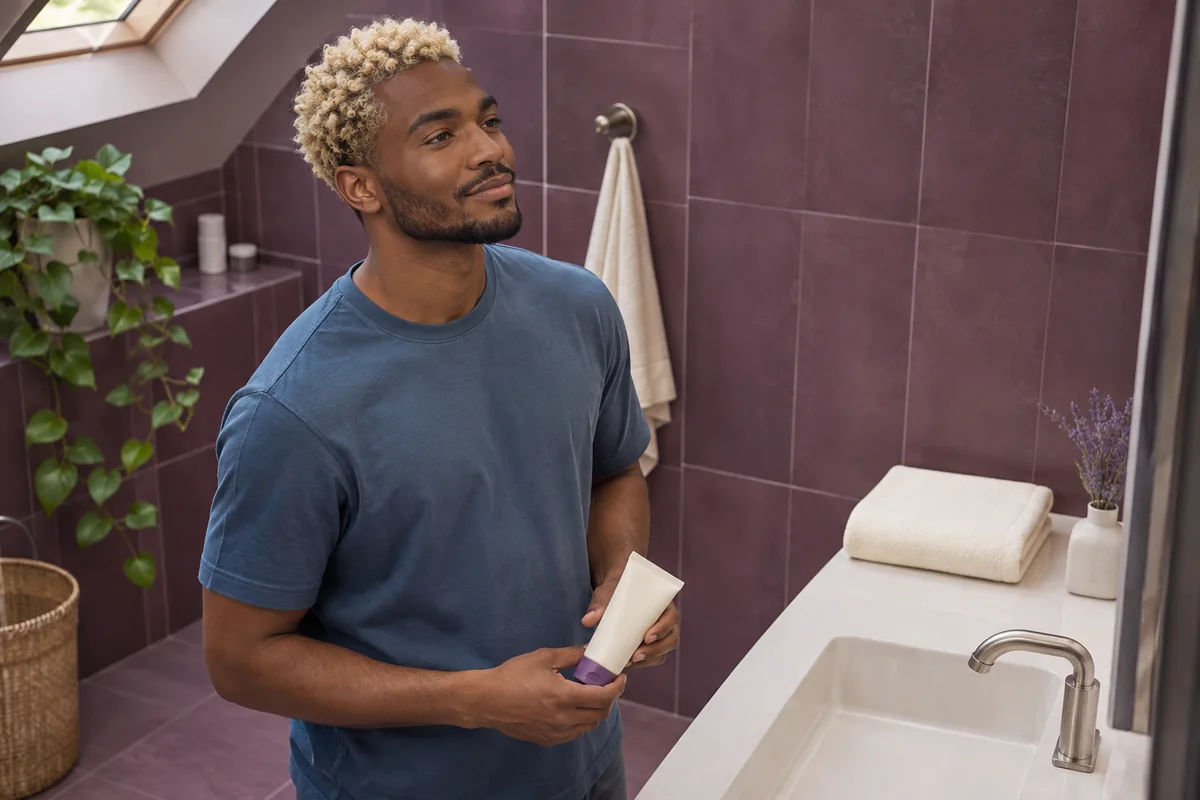
Purple shampoo often reaches the bathroom before the question it is meant to answer. Blonde lengths look warmer under one lamp, a friend suggests a violet bottle, and a video gives a precise number of minutes. Before copying that routine, decide what you see in your own hair. Do you want less visible yellow, a lighter overall colour, softer ends or simply a different finish? Those are separate requests, even when they arrive on the same wash day.
This independent guide helps you plan a colour-care decision without needing an app. Hair Muse publishes it; the photographs illustrate separate situations and do not document a product test or transformation. Start with the bottle you actually own, an ordinary view of your dry hair and enough time to understand the directions before applying anything.
What purple shampoo is being asked to change
Name the colour question in a short sentence. For example, you might like the depth of your blonde but dislike the yellow impression through the ends. That gives you something more useful to discuss than a request for perfect blonde. If you want darker roots to become lighter, the request concerns lightness instead. A pigmented shampoo should not become a substitute for discussing that different service.
John Frieda's manufacturer guide describes violet shampoo as a way to counter visible yellow tones and distinguishes it from lightening. That supports a narrow purpose, not a promise about your particular shade. Its product examples do not establish instructions for another formula, so keep the colour aim separate from the application method.
You may also decide that the colour already suits you. Warmth is a preference question, not an automatic fault that every blonde must remove. If the real complaint is roughness or difficult combing, write that down separately. Our mask-versus-conditioner guide helps organise that care question without expecting a colour product to answer it.
Check the existing colour in an ordinary light
Look at dry hair near a window with indirect daylight, then consider the rooms where you usually see it. Avoid making a decision from one bright bathroom lamp or a filtered photograph. You do not need a professional colour chart to notice that your judgment changes when you move. You do need to acknowledge that change before calling a bottle ineffective or reaching for a stronger routine.
Describe where the unwanted impression appears: the front highlights, lower lengths, underneath section or most of the visible hair. A darker root area and pale ends do not form one identical starting surface. Use plain descriptions rather than guessing a technical colour level from a screen. If you cannot identify the area, save the question for your colourist instead of spreading the uncertainty across the whole head.
Keep one simple reference for your own comparison. Use the same place, ordinary hairstyle and camera settings without a beauty filter, and remember that a photograph remains an imperfect record. It helps you describe what you noticed; it cannot prescribe a pigment, diagnose the hair or prove what a wash will achieve.

Read the whole set of directions before opening the tube
Check the exact name and intended use on your own container. A purple shampoo, a coloured mask and a salon colour product are not interchangeable steps because they share a colour. Find the preparation, application, contact time, rinse and warnings together. If small print is difficult to read, consult the manufacturer's official instructions while your hands are dry rather than guessing in the shower.
Do not borrow a waiting time from a stronger-looking bottle online. Formulas and stated uses differ, and an internet routine does not turn longer contact into a better plan. Follow any required preliminary checks and the stated use conditions. If the packaging is damaged, instructions are missing or the product is not identifiable, resolve that before use.
Recent colouring or a history of unexpected results deserves a specific question to the professional who knows the service. Explain what was done and what you want to change. Ask whether this exact product fits that hair history and whether different areas need different handling. A useful answer is more precise than a general rule for everyone with blonde hair.

Make the wash practical enough to follow
Prepare a way to follow the stated timing without losing track while searching for a towel. Keep the product directions accessible, arrange the rinse and protect clothing or surfaces as the manufacturer advises. This preparation is about making the instructions possible, not extending the process into a complicated home colour service.
Consider whether you can comfortably reach the intended hair. With a short cut, the difference between lengths and nearby skin may be small. With dense or long hair, the accessible front can receive attention while the back is overlooked. Do not compensate for poor access by repeatedly loading the same easy section. If you cannot apply the product as directed, ask for help or postpone.
Keep each preparation in its labelled container. Mixing shampoo with other colour products, adding household ingredients or diluting a formula creates a different preparation with unclear directions. Use the instructed method rather than inventing a gentler or stronger version. If the label leaves an important question unanswered, the manufacturer is the right place to ask.
Keep the rinse and conditioning decisions distinct
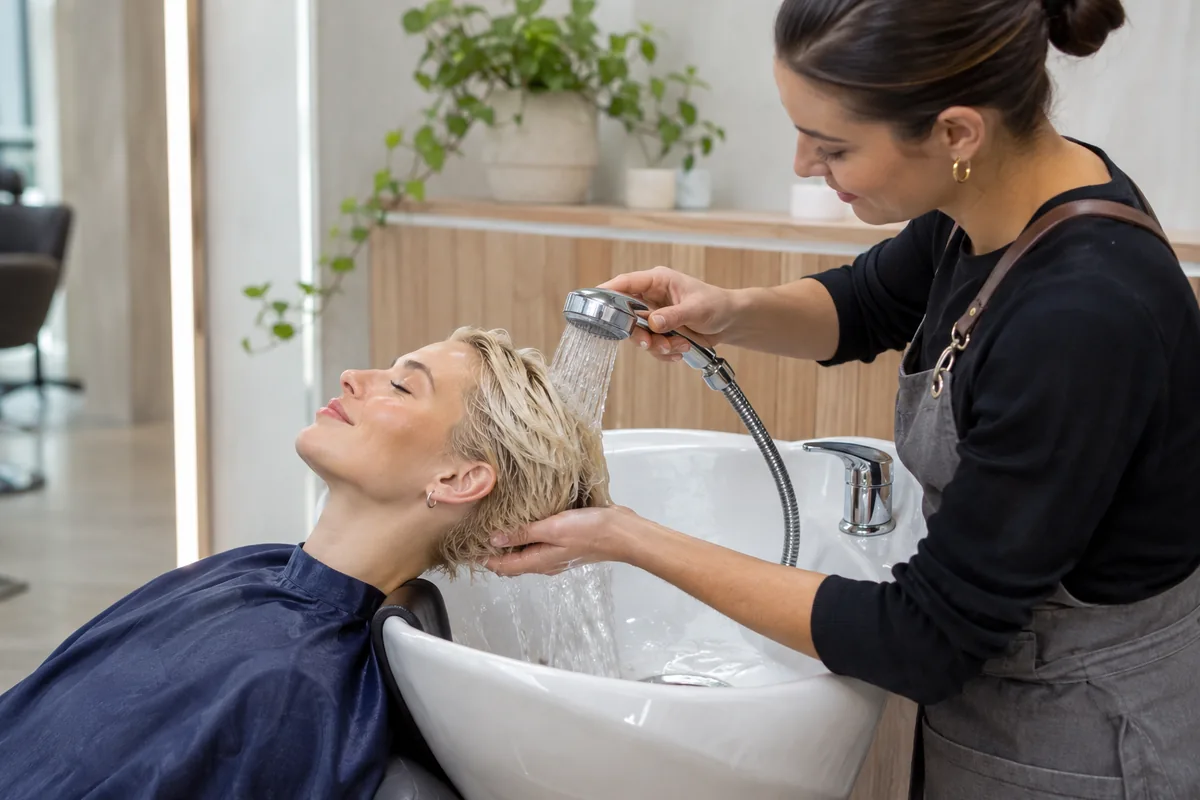
Finish the rinse according to the chosen product's directions, with practical access to the back and lower lengths. Keep the flow away from the eyes and avoid making the scalp uncomfortable through vigorous rubbing. The salon image illustrates access to a rinse; it does not establish a home technique, a water temperature or the result of a violet shampoo.
The American Academy of Dermatology's hair-care guidance separates washing and conditioning and encourages gentle handling. Keep that distinction when planning a pigmented wash: a colour goal does not remove the need to consider ordinary care. Use your conditioning product according to its own instructions rather than assuming a more violet appearance means the hair is better conditioned.
If you usually use a leave-in afterwards, decide on its job independently. Our wash-day sequence guide explains that separate decision. Avoid adding several new finishing layers on the same occasion just to imitate a tutorial. A familiar finish also makes it easier to describe what you see when the hair is dry.
Judge the dry colour before planning another use
Let the hair reach its ordinary dry state before deciding whether the colour question has changed. Compare it in the place you chose earlier, without immediately adding a filtered photograph or unusually bright styling light to the assessment. Write what you can actually observe: the front looks less yellow to you, the lower section looks unchanged, or you remain unsure. Uncertainty is a useful result to record.
Do not turn a general weekly calendar into a requirement to use more pigment. Your next decision should fit both the exact directions and your actual colour goal. There is no single contact time or repeating schedule in this guide. If you are happy with the tone, you do not need to invent a defect to justify using a bottle again.
When the result is not what you wanted, pause before making another colour intervention. Keep the container and explain the application and outcome to the manufacturer or colourist. Avoid trying to correct an unexpected tint with a succession of household acids, baking soda, bleach or repeated harsh washes. That adds new variables before the original problem is understood.

Use a short scenario to organise the decision
Consider an illustrative situation: someone has pale face-framing highlights and darker lengths underneath. In an evening bathroom the front seems yellow, but near the window the warmth is much less obvious. Their first useful step is to describe that difference, not to choose an extra-long application. They keep the product closed until they have read its directions and clarified whether their actual colour goal fits its use.
Suppose the same person also dislikes the feel of the ends. They put that on a separate line in their notes and keep their familiar conditioning step. If they choose to proceed with the labelled colour-care use, they record the exact product and what they followed, then assess the dry hair in the original light. This example describes a process, not an invented successful result.
If they still cannot distinguish unwanted yellow from the natural contrast between areas, they take that uncertainty to a colour consultation. The useful question becomes which part needs attention and why. A specific description can prevent an ordinary maintenance question from expanding into an unnecessary attempt to change the entire colour.
Bring a clear question to a colour professional
Take the actual container, the relevant hair history and a plain description of the area you dislike. Say whether you want to preserve the current lightness and change only the impression of warmth. Mention any previous unexpected tint and what you have already applied. You do not need to arrive with a diagnosis or a technical shade number to ask a good question.
Keep comfort separate from the colour review. Follow the product's warnings; stop using it if it causes irritation and seek appropriate advice for persistent or concerning symptoms. A sudden scalp problem is not evidence that the colour is working. The final aim is a routine you understand: one stated purpose, directions you can follow and a decision based on your own dry hair rather than a copied timer.