

Everyday styling
Hairspray that holds without a hard finish
Give finishing spray one clear job, apply it lightly and check the movement before adding more. A practical routine without product rankings.

Hairspray is easier to use when you give it one small job. Perhaps you want the side of a bob to stay behind your ear, a wave to keep its outline or an updo to look tidy for the journey. Covering every strand heavily is rarely the most useful starting point. First arrange the hair, decide what should remain movable and work only where the shape needs support.
This guide covers finishing a hairstyle with a product intended for that purpose. It does not promise an all-day result or tell you to replace your usual routine. Formulas, nozzles and instructions differ, so the bottle you own takes priority over a universal distance or spray count. You can learn a workable approach without buying a particular brand, copying an elaborate salon setup or making every flyaway disappear.
Give hairspray a clear job
Describe the result before choosing the strength. “Keep the front out of my eyes” is different from “hold this structured updo through an event.” For loose movement, look for language such as flexible or light hold. For a deliberately fixed shape, a stronger finishing product may be appropriate. Those words describe the manufacturer's intended use; they are not a shared scale across every range.
Check whether your hairstyle needs surface support or a different foundation. A spray cannot create a secure bun fastening, repair a loose clip or turn damp roots into a finished blow-dry. If the shape collapses before you even reach for the bottle, reconsider the arrangement first. Our gel-versus-wax guide helps distinguish products used for shaping from the finishing job discussed here.
Choose the smallest useful target: the outer side section, the outline around a part or the loose surface of an already secured style. You do not have to coat the underside, roots and ends equally. Make room for a realistic result too. A few moving strands may suit the day better than a rigid outline that needs constant correction.
Read the bottle before opening it
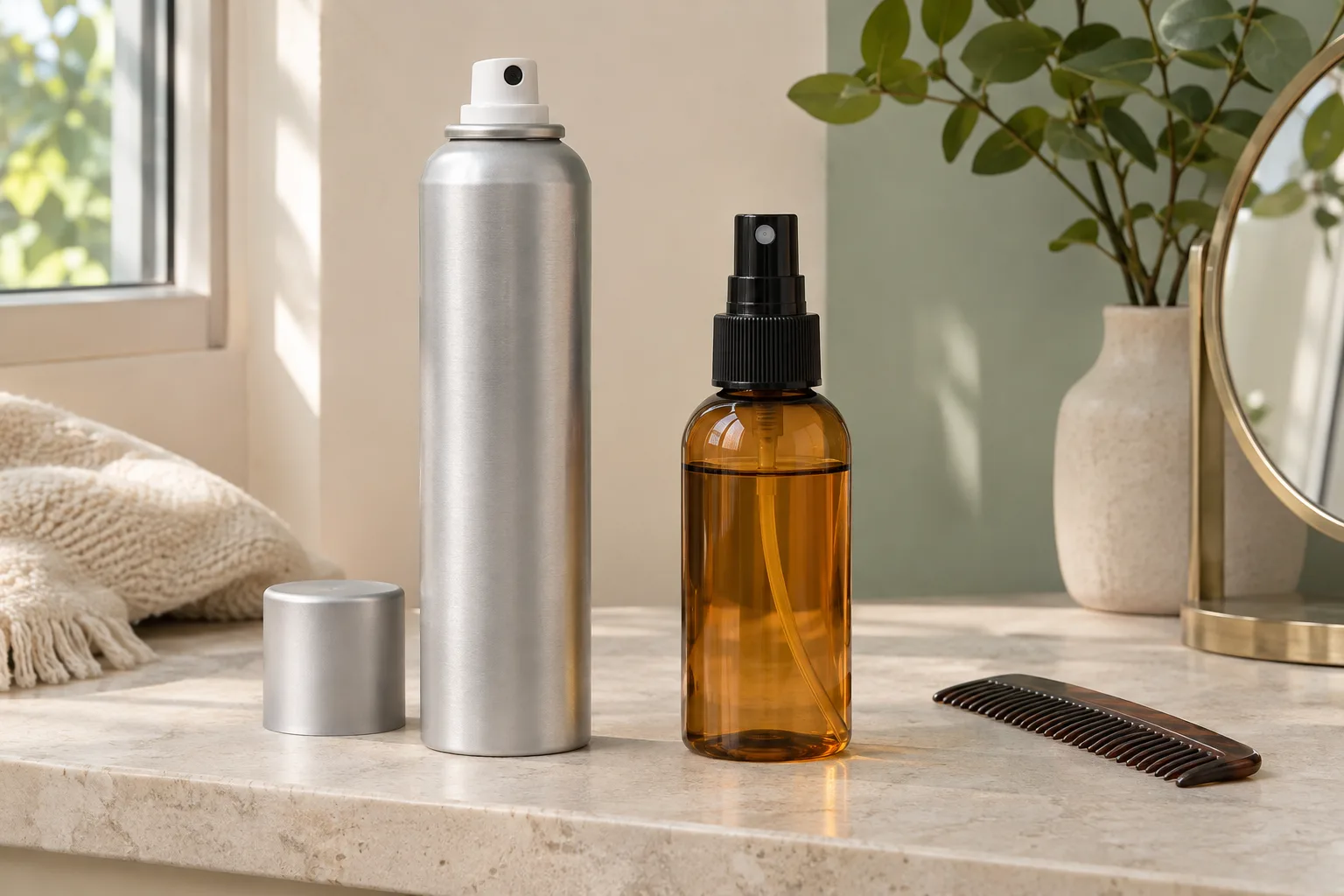
Identify what you actually have. A pump spray and an aerosol can can distribute product differently, and a small travel bottle may behave differently from your usual one. Read the directions, permitted hair condition, application distance and warnings. Follow instructions about shaking or holding the container; do not assume the same action is right for every format or formula.
Use the product in the ventilated setting its label requires. Keep it away from eyes and avoid breathing the spray. Where warnings identify flammability or pressure, follow them carefully: do not spray near flames, smoking or hot styling equipment, and do not heat or puncture the container. Finish the heat-styling stage and put tools away safely before this finishing routine.
Place the bottle on a stable surface between applications and keep the working area clear. If the nozzle does not work properly, follow the manufacturer's cleaning or troubleshooting directions instead of making an improvised repair. Stop using a product that causes discomfort. The aim is an ordinary controlled finish, not finding a way to tolerate a cloud around your face.
Arrange dry hair before trying to hold it
For a finishing spray intended for dry hair, start with the shape already in place and the hair dry. Let hair styled with heat cool before assessing the outline. Damp areas and compressed sections can change as they settle; adding a heavy coat before that happens can make the result harder to judge. A different specialist product may have different directions.
Set your part, release any styling clips you no longer need and secure the fastening of a ponytail or updo. Look at the front and one side rather than repeatedly touching the whole head. If a section simply needs moving, move it now. Hairspray is easier to place when you are supporting an arrangement instead of trying to build it inside a wet coating.
Keep other styling steps distinct. Mousse, for example, may belong earlier in your particular routine, depending on its directions; another layer of finishing spray is not automatically a replacement for it. The separate mousse application guide covers that choice. For this session, keep familiar products and a familiar hairstyle so you can notice what the spray itself contributes.
Start with one light, controlled pass
Use the distance stated on your bottle. Holding it extremely close can concentrate product on a small patch, but moving farther away than instructed is not a guarantee of a better result either. Stand comfortably and aim at the intended outside area while keeping spray away from your face and other people. Do not use a photograph as a precise measuring guide.
Follow the label's application method and begin lightly. If it calls for movement, move the container across the area instead of continuing to soak one spot. There is no universal number of seconds or pumps for every nozzle, hair length and formula. You are looking for an even useful application, not a visible wet layer as proof that enough has been used.
Allow the product to settle as directed before judging whether more is needed. Repeatedly squeezing the same strand between your fingers can make that decision less clear. Look at the overall shape, then make one small adjustment only if necessary. You can stop after the first pass; finishing the bottle's suggested method does not create an obligation to keep adding layers.

Change the target to suit your hair
On fine hair, pay attention to how the roots and ends respond separately. If an outer section needs support, there is no reason to saturate the entire crown to match it. A flat patch may need a different arrangement or a lighter product next time. Adding more spray to hair that already feels coated is unlikely to clarify what went wrong.
On waves or curls, keep the groups you want to preserve in view. Avoid repeatedly pulling them apart to distribute a finishing product as though you were detangling. Choose a formula and method appropriate for that use, follow its directions and leave settled groups alone where possible. Support can mean maintaining an outline while accepting some movement and ordinary variation between sections.
With short hair, a fringe or hair near the face, accurate placement may be difficult. Do not compensate by spraying directly toward your forehead or eyes. Use only a label-supported method you can control comfortably. For an updo, check pins or other fastenings first: spray can support its surface finish, but a failing fastening calls for a fastening adjustment.
Check movement before you add more
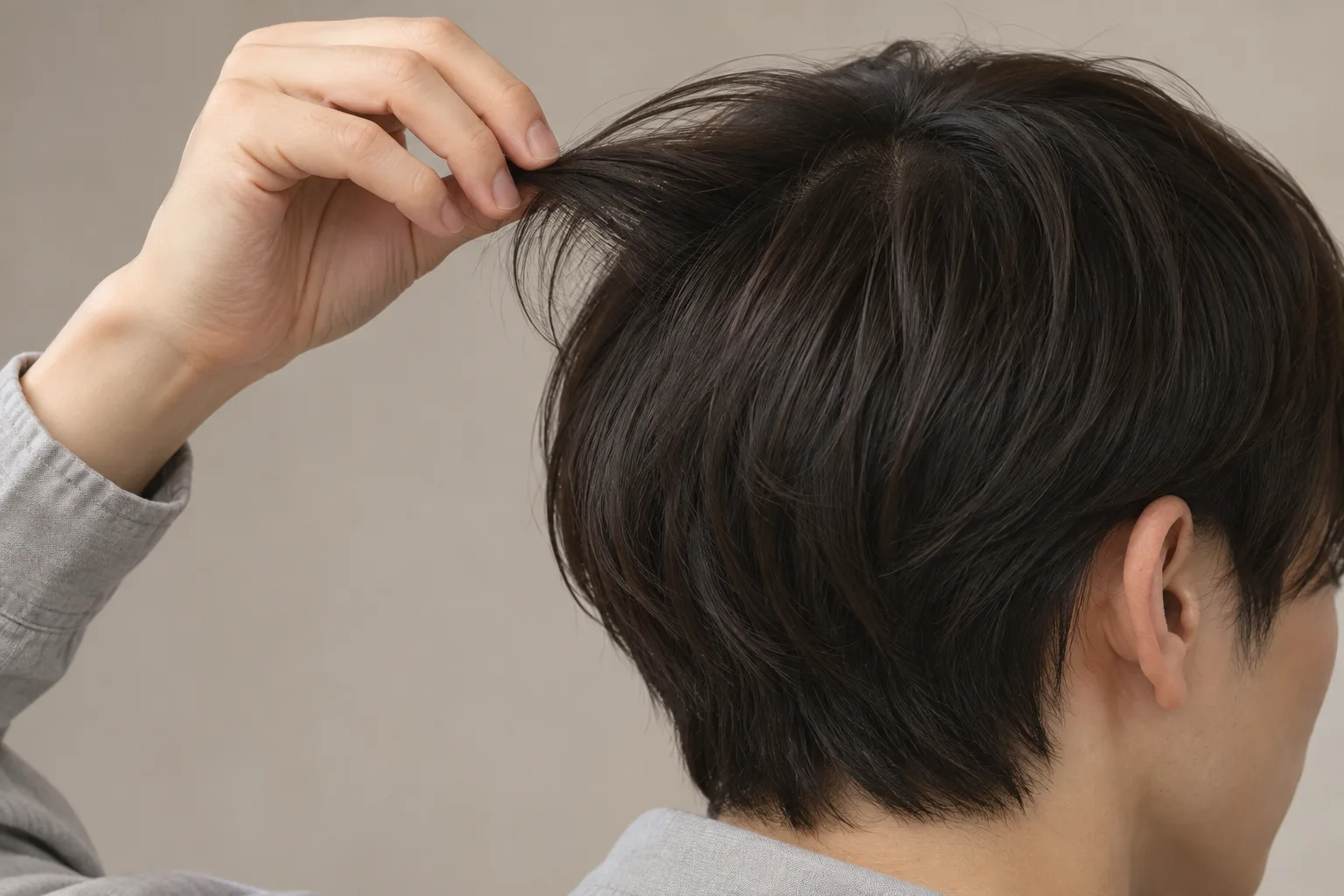
Once the product has settled, turn your head normally and look at the silhouette again. Are the sections you wanted to support staying approximately where intended? Does the rest still move in a way you like? A finish does not need to feel identical to untreated hair. Judge it against the small job you chose, rather than a perfectly still photograph.
If one area looks flatter or shinier than you wanted, stop coating it. More product can make that patch more noticeable instead of making the surrounding hair match. For the next session, consider a lighter application, a more appropriate hold level or a smaller target. Change one variable at a time so the comparison gives you useful information.
For an event, leave a little time to assess the finish before walking out. Check the collar, glasses or hair accessory you will actually wear. You may find that tucking a section or repositioning a clip solves the practical problem. That is a successful adjustment, even if it means the spray has less work to do than you first expected.

Reset a coated area without forcing it
If hair feels stiff or sticky, do not repeatedly rake a brush through a hard coating. Some flexible formulas are explicitly designed to be brushed out; others are not. Follow the specific product's removal directions. When you cannot comfortably rearrange a section, washing with your normal suitable routine can be a clearer reset than layering water and more products over it.
Avoid bringing a hot tool back into a heavily sprayed section to reshape it. This guide treats finishing as a step after heat styling, not permission to combine an unspecified spray with heat. Check the product and appliance instructions if your routine involves both. A finishing spray is not automatically a heat protectant simply because it appears in a styling demonstration.
After removing the coating as directed, handle tangles according to your hair's needs instead of pulling through resistance. Our gentle-detangling guide explains why the appropriate wet or dry approach depends on texture and routine. If a product repeatedly leaves a finish you dislike, reduce the amount or reconsider the formula; you do not need to force yourself to finish using it.
Make touch-ups a decision, not a habit
Later in the day, look at what actually changed. A flattened section after a hat, a loosened fastening and an outer flyaway are different problems. Restore the arrangement first where practical, then decide whether a small label-supported touch-up is useful. Repeating the whole application automatically makes it harder to keep track of how much product is already there.
Keep a short note for the next attempt: the product, the area treated and the finish after settling. “Sides held; fringe felt too firm” is more useful than “hairspray did not work.” This is a personal routine observation, not a controlled test of performance. Weather, activities and the hairstyle itself can all change the outcome between days.
- Choose the movement you want to keep and the area that needs support.
- Read the exact bottle's use, distance and safety directions.
- Arrange the hairstyle, finish any heat styling and assess it dry.
- Apply lightly, let it settle and stop when the small job is done.
- At a touch-up, check the existing coating before reaching for more.