
An easier evening routine
Does your satin bonnet have room for your hair?
A cap that slips, squeezes or crushes your ends is a reason to check the fit. Check the lining, space and bedtime movements before tightening anything.

A satin bonnet sounds like a small addition to bedtime until the band creeps over your eyes, the crown feels crowded or you wake with an uncomfortable edge against your skin. Tightening the opening is not the only possible response. The cap may have too little room for your hair, a shape that moves awkwardly on your pillow or an inside seam that you would rather not have rubbing in that position.
This guide helps you inspect the bonnet you already have, put dry hair inside without forcing it and decide whether the arrangement is worth keeping. It is a practical comfort routine, not a product ranking or a promise of perfect curls. The pictures illustrate separate editorial situations, not a tested before-and-after result. A useful night accessory should fit around your hair and sleep habits, rather than require you to tolerate pressure to earn a better morning.
Choose a satin bonnet for one useful job
Name the problem you actually want to solve. Perhaps loose lengths keep falling across your face, the back of a style gets disturbed or you would like the hair contained while you turn in bed. Pick one aim for the first try. Asking a cap to straighten, moisturise, repair ends and preserve every curl at once makes it difficult to judge what it is doing. It is an accessory, not a replacement for washing, conditioning or a haircut.
You also do not have to wear one simply because your hair resembles someone else’s. Bonnets are especially familiar in textured-hair routines, but the useful question here is whether this particular arrangement suits you. Short coils, long waves and a loose braid take up different spaces. Keep the approach optional. If a cover interrupts your sleep or feels unpleasant, a simpler arrangement can be the more useful choice, even if a polished photograph makes a cap look effortless.
Inspect the lining as well as the name
Turn the bonnet far enough inside out to see what will touch your hair. Look at the inner surface, seam joins and edge rather than relying on the shine outside. A smooth-looking shell may conceal a different lining. Run clean fingers lightly across the inside to notice a rough join, loose thread or damaged area. Check the care label too: an accessory that cannot be washed and dried conveniently may be awkward to keep in your actual routine.
Satin describes a weave, as the V&A textile glossary explains; the word alone does not identify every fibre or care requirement. Read the stated composition instead of assuming that every satin bonnet is silk or that a higher price proves a better fit. There is no need to become a textile specialist before bedtime. The practical checks are a suitable inner surface, intact construction and instructions you can follow without guessing.
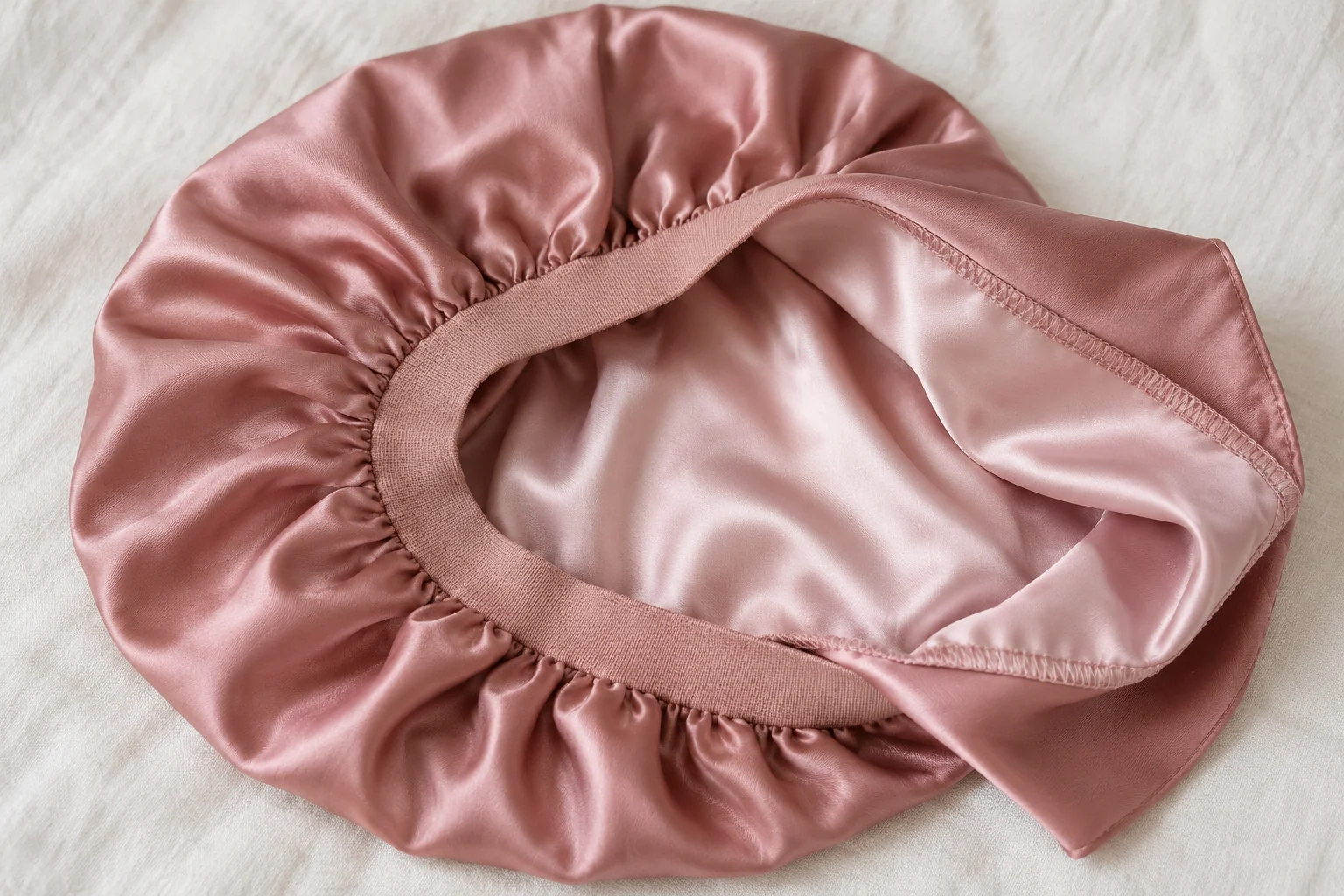
Separate room for the hair from grip at the edge
A larger opening and a deeper cap are different features. Your band may feel loose while the crown still has too little space for the bundle inside. Before fastening anything, gather your hair lightly in your hands and notice its ordinary volume. Do not twist it into a hard rope just to prove that it fits. Look for enough room to place the lengths without pulling the roots or trapping the ends beneath the elastic.
For longer hair, support the lower lengths while bringing the fabric around them. You may need to fold the lengths loosely into the cap, rather than pack everything at one point. For shorter hair, check that the spare fabric is not dragging the edge towards your face. There is no universal centimetre or finger-count rule that selects the right bonnet for everyone. A comfortable fit is something to assess on your head, with your hair arranged as you intend to wear it.
Prepare the hair without adding another tight style
Practise with dry hair first so that drying and bonnet fitting are separate tasks. Remove the rigid claw clip or pins you used during the day. Release a tight daytime ponytail before deciding how to place the lengths. If a small area is tangled, work on that area gently rather than dragging the entire bundle into the cap. You are trying to make the arrangement easier to wear, not produce a perfectly slick foundation that nobody will see.
Loose hair may fit without another fastener. If you prefer a loose gathering, check the roots separately after making it: does moving your head pull at the front or behind the ears? Our low-ponytail guide explains how to assess that gathering point without relying on extra tension. Do not stack a tight tie, a tight band and a second cover just to keep the first accessory on. Simplify the arrangement before adding another layer.

Put it on and check ordinary movements
Open the band with both hands before bringing it towards the hair. Guide the fabric around the supported lengths, then check the nape and sides for ends caught under the edge. Settle the band where it feels comfortable; the photograph is not a placement template that overrides your own hairline, ears or preferred sleeping position. If a seam bothers you, inspect how the cap is constructed rather than automatically wearing it inside out against its intended lining.
Turn your head, look down and rest briefly in your usual sleeping position. Notice sliding, a crowded knot of hair or an edge pressing against an ear. The American Academy of Dermatology advises keeping hair loose beneath a covering and taking pulling pain seriously. Loosen or remove an uncomfortable arrangement. Persistent irritation or changes in the hair or scalp deserve professional advice; a tighter bonnet is not a treatment or a way to conceal an unresolved problem.

If it slips, diagnose before tightening
Notice which part moves first. Does the cap slide backwards because the lengths pull it down, roll forwards when your head touches the pillow or simply have an opening that does not suit you? Take it off and adjust the hair distribution before changing any fastening. If there is an adjustment designed into the bonnet, use it according to its instructions and repeat the comfort check. A band that stays put only when it hurts has not solved the problem.
Avoid improvising extra pins, a rigid clip or a tightly knotted cord near the place where you rest your head. Do not keep stretching an old elastic beyond its intended range, either. Sometimes a different cap depth or band construction is the relevant change; sometimes you would rather use no cap. You can consider a smooth pillowcase if that feels simpler, while recognising that it does not contain the lengths in the same way. There is no need to buy both immediately.
Wash and dry according to the actual label
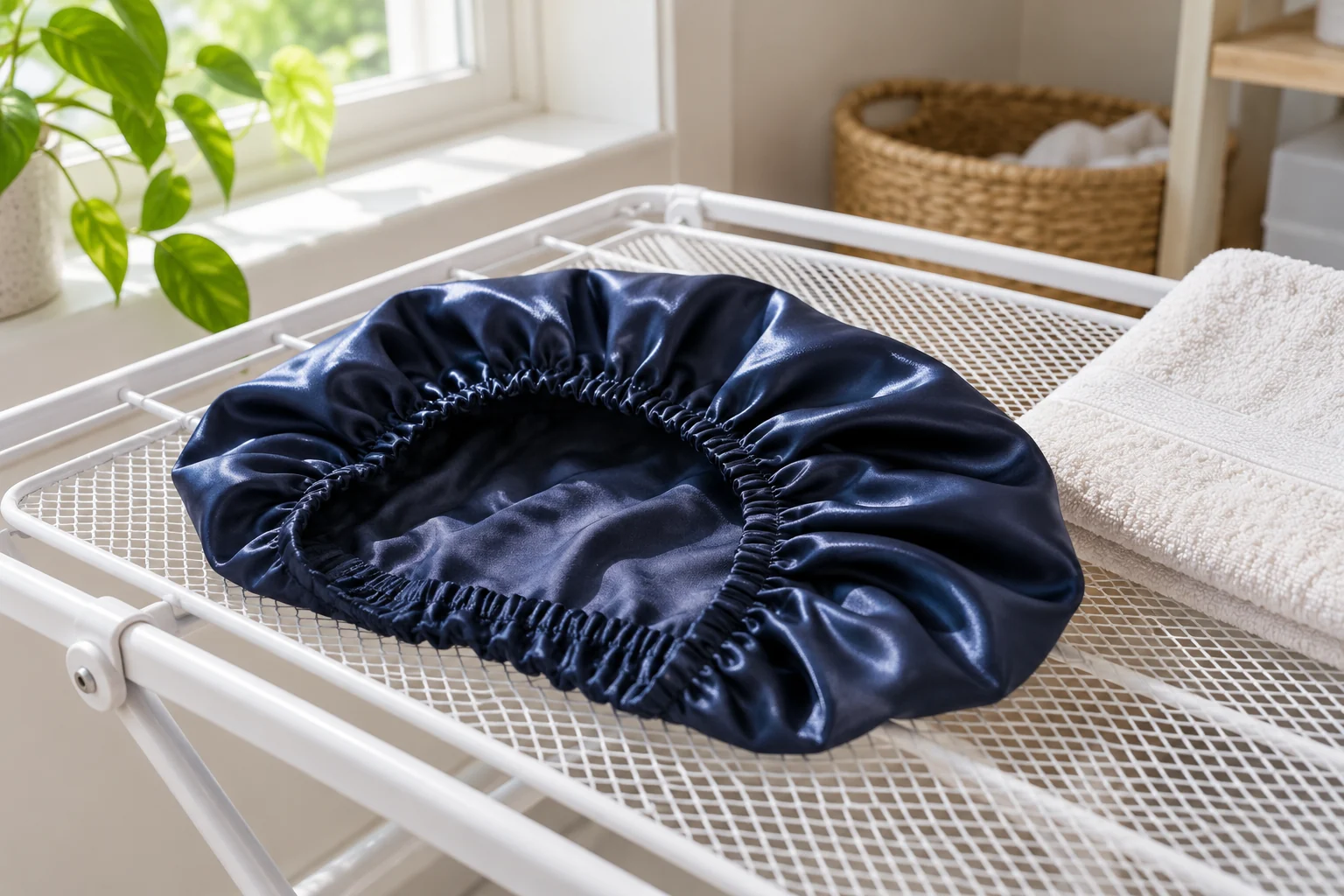
Check the bonnet for product residue, a damp lining or a change in how the inside feels. Follow its own washing directions, including any temperature, hand-wash or drying restrictions. Do not assume that instructions for a silk item apply to a synthetic one, or that every elastic tolerates the same heat. A spare cap can make laundry easier if you already own one, but a large collection is not required to begin a useful routine.
Let the fabric dry fully before using it again or putting it into a closed pouch. Arrange it without stretching the band over an oversized object. Keep a clean cap somewhere you can reach without dropping it among styling residue or wet towels. Rather than inventing a universal washing interval, use the label and the condition of the accessory to plan when it needs attention. If a seam breaks or the surface develops a snagging patch, set it aside until it can be safely repaired or replaced.
Release it gently in the morning
Open the edge before lifting the cap away. Check that short pieces at the nape and temple are free instead of pulling the entire bonnet off over caught hairs. Let the lengths settle before deciding what needs fixing. A flattened area is not evidence that your whole routine failed, and a good-looking morning is not proof that the accessory repaired damage. Judge the specific thing you wanted it to do, together with the comfort of the night.
If just one curl group needs attention, deal with that part rather than wetting or restyling everything automatically. Our curl-refresh guide describes a local next-morning reset, which is a different task from fitting the bonnet the evening before. Keep the first few comparisons simple: note whether the cap stayed comfortable, whether the ends were contained and what you actually had to redo. Changing several products and your sleeping arrangement together makes that judgment much harder.
Keep the routine only if it earns its place
A workable result is specific and ordinary: the band felt unobtrusive, the lengths fitted without tension and taking it off was easy. If those things do not happen, change one practical variable or stop the experiment. You do not have to work towards a flawless hair photograph after every night. Differences in the day’s styling, how you slept and the condition of the hair can affect what you see in the morning.
Write down a small adjustment if it helps, such as leaving more room at the crown or removing a second fastener. Treat the illustrations as explanations of handling, not as results you must reproduce. Hair Muse publishes this guide; an app preview cannot assess a bonnet’s pressure, fabric feel or overnight comfort. Those decisions come from the real accessory and your own experience. The aim is a manageable evening and morning, not another requirement to get your hair right.