
Short haircut planning
Growing out a pixie cut: plan the in-between stages
Keep the crown growing, decide what to do at the nape, and make each awkward length serve the longer cut you actually want.

Growing out a pixie cut is not simply a matter of refusing every trim. The top, sides, fringe, and nape reach usable lengths at different moments, so the silhouette may change long before the hair feels long. You can protect the length that matters while making deliberate decisions about the areas that crowd the ears or collar. The first question is not ‘How many months until a bob?’ but ‘Which shape do I want to wear on the way there?’
This guide is for someone who already has short hair and wants a practical transition, not for someone deciding whether to cut long hair short. Hair growth varies by person, texture, health, and starting cut. A photo can show today’s outline, but neither a calendar nor an AI preview can promise an exact future length. Use the stages below as decisions to revisit, not dates to obey.
Growing out a pixie cut starts with a destination
Name a first destination rather than an indefinite wish for longer hair. Is it a soft bixie that still exposes the neck, a compact bob with an even lower line, or enough length to tuck both sides behind the ears? Each goal asks you to preserve a different area. A bob may need the crown and upper sides to catch up with the back; a textured crop can tolerate more unevenness. Aiming for shoulder length immediately hides the useful decisions in between.
Take unfiltered photos today from front, both sides, and back with dry hair in its everyday state. Mark the shortest and longest visible areas. Choose a single milestone you could recognize in a mirror, such as the upper side reaching the top of the ear. If you change the destination later, that is normal. The record prevents a routine tidy-up from quietly resetting the one section you meant to grow.
- First wearable target, not an idealized final photo
- Length to protect at the crown and upper sides
- Areas that may need shaping without losing the goal
- One everyday function, such as an ear tuck
Understand why the nape can look ahead of the crown
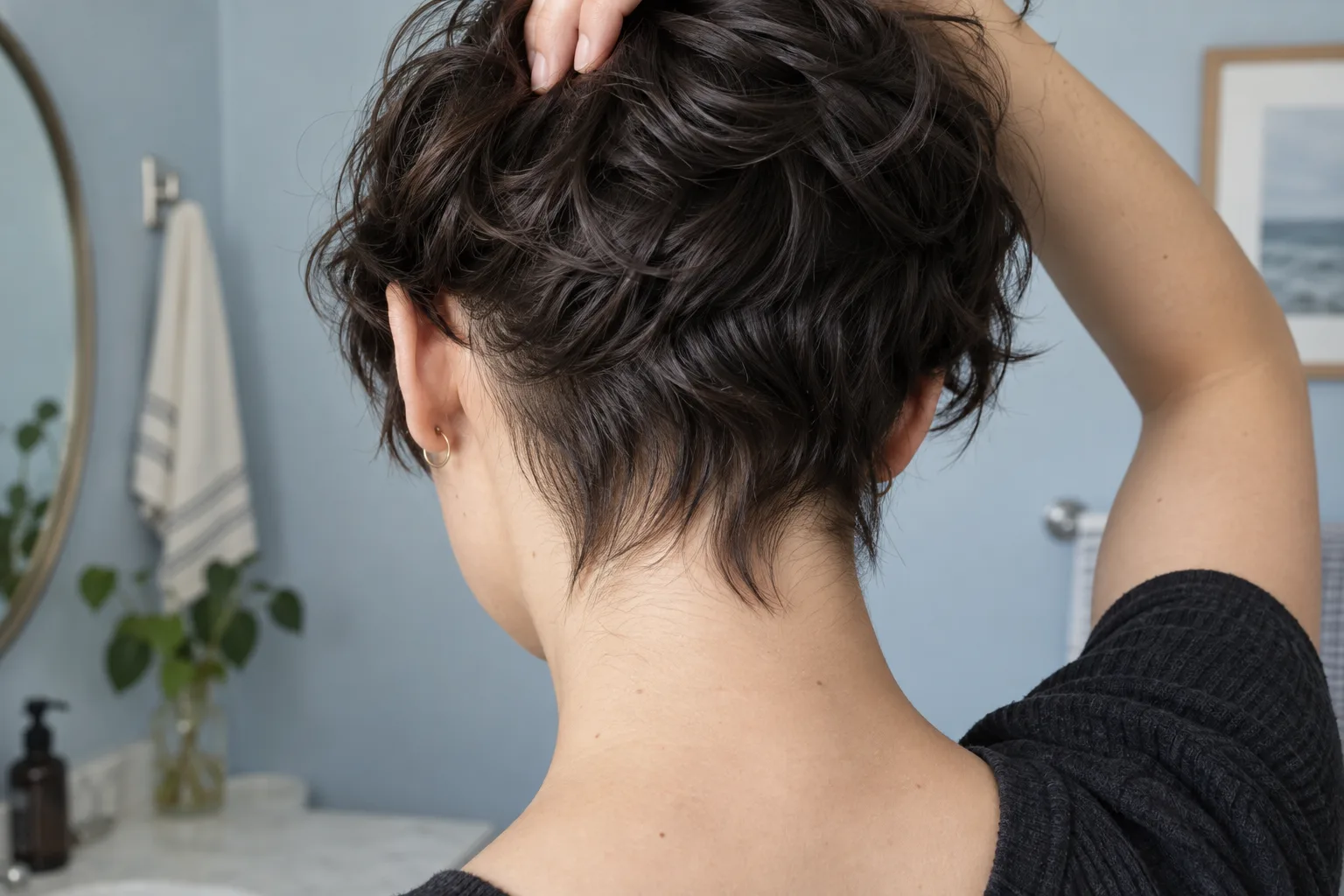
A very short nape sits low on the head. Even when every strand grows, the lower hair can reach the collar while the crown still reads as short. This is a geometry and starting-length problem, not proof that one region is growing at a dramatically different biological speed. Cowlicks, tight curls, straight texture, and the way the back was originally tapered all change how pronounced the contrast looks.
Check the back in a photograph rather than by pulling one strand in the mirror. Decide whether the longer nape is a shape you enjoy or a distraction from your chosen destination. A light contour tidy may help while leaving the upper lengths alone, but repeated heavy removal can also delay a longer lower edge. Describe the visual problem to a stylist before consenting to a standard pixie refresh.
Choose a trim strategy, not a universal appointment interval
There are two reasonable routes. Keep almost every strand growing if speed and a deliberately shaggy outline matter most. Or ask for limited shaping at the nape and perhaps around the ears if a controlled silhouette makes the process easier to wear. Neither route guarantees faster growth. Trimming changes the visible shape and can remove compromised ends; it does not make follicles produce hair more quickly.
At the appointment, say explicitly which zones are protected and show their current length in a dry photo. Ask the stylist to explain what they would remove and why before cutting. A few millimeters at the lower contour can be different from resetting the sides and crown to a fresh pixie. If the proposed trim would erase your milestone, postpone it or agree on a smaller adjustment. Let your own shape, not a fixed four-week rule, set the next review.
Useful salon sentence: ‘I am growing the crown and upper sides; please show me what you would remove at the nape before cutting.’
Treat the ear and side pieces as a separate stage
The first side sections to reach the ears often stick out, fold under glasses, or refuse to stay tucked. That does not mean the overall cut has failed. Observe whether the piece is too short to tuck, thick enough to push outward, or simply growing in a strong direction. Each calls for a different response. Cutting it short again solves today’s irritation but may repeat the same stage next month.
Try a change of part, a loose clip, or a soft headband before asking for length removal. If the upper side is already long enough to tuck but the lower side is bulky, a stylist may be able to adjust the shape without sacrificing the useful top length. Photograph both sides; asymmetry is common even with a careful cut. The goal is not mathematical symmetry but a daily routine that works as the transition continues.

Let natural texture determine the visible checkpoint
Straight hair may show each new centimeter at the outline; waves can flip near the ear; curls and coils can gain strand length while the dry silhouette looks nearly unchanged. Compare dry-to-dry photos taken with similar products and lighting. Stretching a curl for a measurement answers a different question from how the cut looks on an ordinary day. Do not use a wet guide line as the promised finished endpoint.
Choose a shape that leaves room for your density and growth pattern. A closely cut nape can feel sharp on straight hair but spring up in coils. Thinning a dense side to force a temporary flat shape can create sparse patches as it grows. On fine hair, repeatedly removing weight may make the perimeter look less full. Bring real dry photos to the stylist; the texture should inform the transition rather than be treated as a problem to conceal.
Use low-tension styling to make a difficult week easier
An in-between cut does not need an elaborate daily rescue. Try one small action that solves the current problem: a side part for a falling fringe, a soft band for a workout, or a smooth clip that holds only the upper side. Choose accessories that do not pinch or pull at the hairline, and move their placement rather than fastening the same spot tightly every day. A slightly imperfect outline is often more comfortable than a rigidly controlled one.
If you blow-dry for direction, use the lowest effective setting and reduce frequency when possible. The American Academy of Dermatology advises limiting excessive heat and handling wet hair carefully, with texture-specific exceptions for detangling. A diffuser, air-dry routine, or small amount of suitable product may be enough, depending on your hair. Styling should make the present stage usable; it should not be a promise that the eventual cut needs identical effort.

Watch progress in comparable photos, not a rigid timeline
Hair grows through cycles and at different rates. Cleveland Clinic describes an average of roughly four to six inches per year, but an average cannot tell you the month your own crown will meet your own nape. Starting lengths, curl shrinkage, trims, breakage, and the endpoint you choose all affect the visible journey. A precise month-by-month pixie-to-bob schedule would sound reassuring but would not be reliable for an individual reader.
Take a quick set of photos every few weeks with similar part, lighting, angle, and dry texture. Compare the same landmarks: does the upper side pass the ear, does the front reach the cheek, and does the back sit comfortably above or on the collar? Note whether a new styling option appears. If you see unusual shedding, scalp pain, or significant breakage, seek appropriate professional advice instead of assuming a different haircut or a supplement will solve it.
Make the next salon visit a focused conversation
Bring your current front, side, and back photos and a sentence naming the destination. Point to the area you want to grow and the one that bothers you now. For example: ‘I want the top to reach my ears, but the nape flips against my collar; please keep the top length and show me a gentle back adjustment.’ Include your natural texture, usual part, glasses or headwear, and the amount of heat styling you actually accept.
Ask what the stylist would remove today, what that buys you in the next few weeks, and what it might delay. Check the result dry if feasible and ask for a low-effort home version. Record the agreed plan so the next appointment does not start from the assumption that you want the original pixie recreated. A good grow-out visit protects the longer-term aim while solving a present problem, not every imagined future problem at once.

Decide whether a preview adds anything to this decision
If you are torn between a soft bixie and a compact bob, a visual preview can help you name the outline you prefer. Use one clear current photo, compare one meaningful difference at a time, and keep a small shortlist of two or three directions. Hair Muse is free to download, though some previews or usage levels may require an in-app purchase. Its images can support a conversation; they cannot forecast hair growth, curl behavior, hidden cutting structure, or salon feasibility.
For a decision about what to trim this week, your real back and side photos may be more useful than a generated future look. Reject a preview that changes your face, density, hairline, or texture to make one option appear better. Label the feature you like instead of asking for a pixel-perfect copy. The independent plan still works with no app: observe today’s hair, choose the next wearable milestone, and make limited, explicit trim decisions.