
Fine hair planning
Free hairstyle try on for fine hair: compare fuller shapes
Compare perimeter, length, crown height, movement, and daily effort on one clear photo before turning a fuller-looking shape into a salon brief.
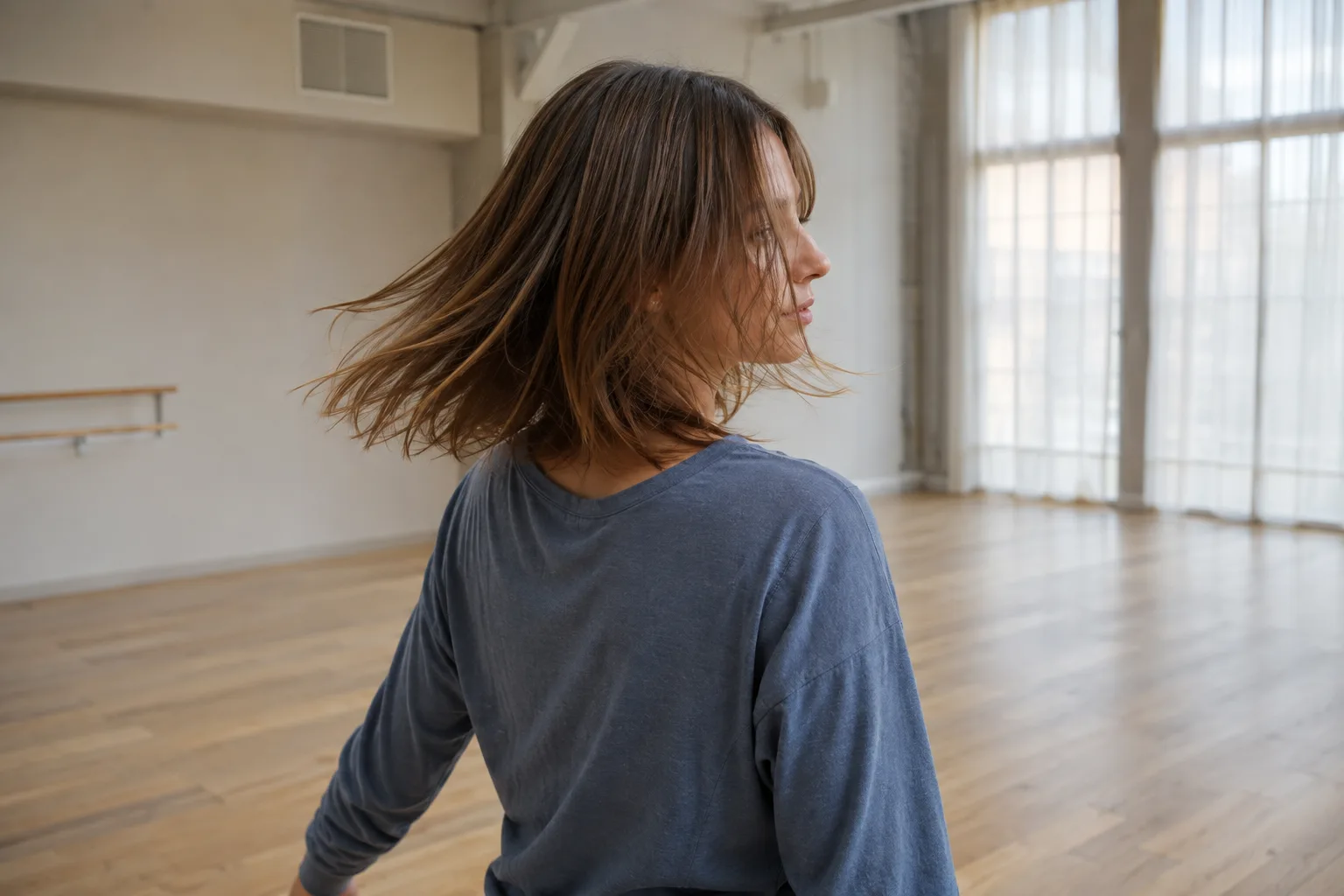
A free hairstyle try on for fine hair is most useful when it compares visible shape instead of promising to create more hair. Fine describes the diameter of individual strands; it does not tell you how many strands you have, where density changes, or how your roots and ends behave. A person can have many fine strands, sparse areas, straight hair, waves, curls, or a mixture. Those differences matter more than a generic rule such as ‘fine hair must be short’ or ‘layers always add volume.’ Start by defining what fuller means in your own mirror: a stronger lower edge, more height at the crown, less transparency through the ends, or a silhouette that keeps its shape between wash days.
Hair Muse is free to download and can help you compare those broad visual directions on one clear photo; some previews or usage levels may require an in-app purchase. The app cannot measure strand diameter, count density, diagnose thinning, choose a cutting technique, or predict how your hair will react to humidity, products, heat, or growth. Treat every generated image as a discussion sketch. The workflow below keeps the source photo stable, changes one shape variable at a time, rejects misleading results, and converts two or three useful observations into a brief that a qualified stylist can adapt to your real hair.
Define fine hair and the kind of fullness you want
Look at fully dry hair on an ordinary day from the front, both sides, and the back. Separate four questions: how easily you see space between strands, how solid the lower edge looks, where the widest point sits, and how much height remains several hours after styling. Do not use a single overhead bathroom light as proof of density; hard light can expose scalp and separate strands far more than diffuse daylight. Photograph the same parting in even light and write down visible relationships rather than judging your hair as flat, bad, or thin.
Now choose one result you actually want. ‘More volume’ can mean crown lift without wider sides, a jaw-length outline that reads as one line, movement around the cheek without transparent ends, or enough body that the hair does not disappear against a jacket. These aims can conflict. Short layers may lift one zone while reducing the amount of hair reaching the perimeter. A compact edge may look fuller but move less. Ranking the result prevents a preview from winning simply because it looks glamorous.
- Primary goal: crown height, side width, perimeter strength, or movement
- Area to protect: hairline, temples, front density, or lower edge
- Daily limit: drying, heat, product, brushing, and refresh time
- Functional need: tuck, tie, headset, helmet, or low-maintenance finish
Read the perimeter before asking for layers
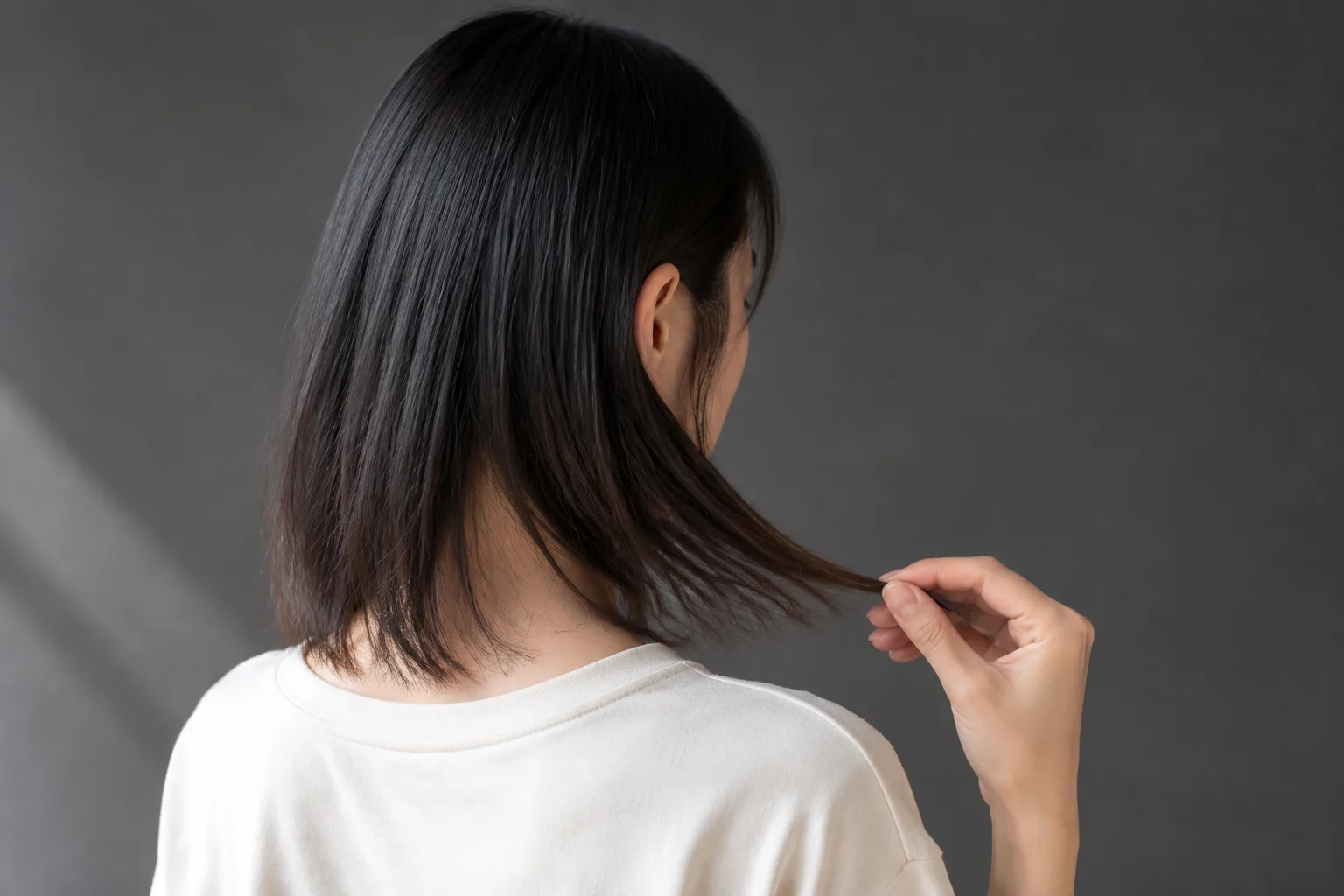
Place the ends against a plain top that contrasts with your hair and look at the bottom three to five centimetres. A continuous line, separated wisps, a rounded edge, and a tapered edge create different impressions even when the total length is identical. Check the front and back separately because face-framing pieces may be much lighter than the rear perimeter. If the ends already show gaps, removing more exterior length may make the outline airier, even when the upper shape appears lively in a styled reference.
This is not an argument against layers. It is a reason to describe their destination. Ask whether movement should begin near the cheek, below the jaw, through the interior, or only near the ends. Show the stylist areas affected by old layers, color, breakage, or regrowth. A photo cannot reveal the condition or connection of hidden sections, so avoid prescribing a razor, thinning shear, or named technique. Protect the visual edge first, then discuss how movement can be built without sacrificing the part you value.
Set up a repeatable source photo
Use a front-facing portrait at eye level with the whole head, hairline, neck, and shoulders visible. Stand in soft window light or another even source, keep the background quiet, and move far enough from a wide-angle phone lens that the centre of the face is not enlarged. Wear a simple top whose tone separates from your hair. Start with your usual part and an ordinary dry finish; a heavily teased or freshly salon-styled base makes everyday comparisons harder to interpret.
Save that image as the control and reuse it for the entire session. If you need another angle, make it a separate comparison rather than mixing front and three-quarter images in one shortlist. Camera height, distance, crop, expression, clothing, and light should stay steady. The existing photo guide explains these variables in more detail. Consistency does not make the preview physically accurate, but it reduces the number of unrelated changes competing for your attention.

Use a free hairstyle try on for fine hair one lever at a time
Create a small sequence rather than a gallery of unrelated makeovers. First compare endpoint while keeping part, color, texture, fringe, and finish similar: for example, jaw, neck, and collarbone. Next keep the preferred length and compare a compact lower edge with a slightly softer one. Only then test where visible height or movement sits. Changing length, color, curl pattern, fringe, and root lift together may produce an exciting image, but it cannot tell you which decision improved the silhouette.
Name each result by the variable, not by a verdict: ‘jaw endpoint,’ ‘soft lower edge,’ or ‘height above temples.’ Limit the shortlist to two or three images plus the original. Hair Muse can support this controlled comparison, but generated hair may cover different areas, invent strands, or change the apparent head shape. If a result alters the face, hairline, shoulder width, camera crop, or lighting enough to affect your reaction, exclude it even when the hairstyle itself looks attractive.
- Round one: endpoint and overall length
- Round two: solid versus softened perimeter
- Round three: crown, temple, cheek, or jaw emphasis
Test the shape against movement and your routine
A still, polished image can hide the effort behind a shape. On a normal wash day, record how long you actively dry and direct the roots, which products you use, and when the hair loses its initial lift. Walk outside, put on common clothing, move the part, and check the shape again. Fine strands can be straight, wavy, curly, or coily, and the same cut may separate, expand, collapse, or hold differently according to pattern, density, condition, weather, and handling.
The American Academy of Dermatology recommends limiting excessive heat, allowing hair to partially air-dry before styling, and avoiding practices that create repeated tension or breakage. That general care guidance does not determine your haircut, but it is a useful reality check when a reference requires daily high heat, aggressive backcombing, or tight securing. Define the maximum routine you would repeat on a busy morning, then ask whether the preferred silhouette still makes sense inside that limit.

Reject previews that manufacture fullness
Remove any preview that adds an implausibly dense hairline, hides the ears differently, fills transparent areas with a uniform block, or changes the curl pattern without that being the chosen variable. Also reject a result if the head becomes wider, the neck narrows, the shoulders move, or the lighting creates a false contrast around the perimeter. These errors are not small cosmetic details when your decision is specifically about visible fullness; they can make one option seem stronger for reasons unrelated to the cut.
Keep a short rejection note. ‘Hairline changed,’ ‘too much invented root lift,’ or ‘texture no longer matches’ is enough. A failed preview can still clarify the boundary of your request, but it should not be shown as an attainable promise. If every result relies on the same unrealistic fullness, stop the session and use ordinary haircut references instead. A useful planning tool reduces uncertainty about preference; it should not encourage certainty about hair behaviour it cannot observe.
A believable preview preserves your identity and starting conditions. It does not need to look spectacular to be useful.
Turn two preferred shapes into a salon brief
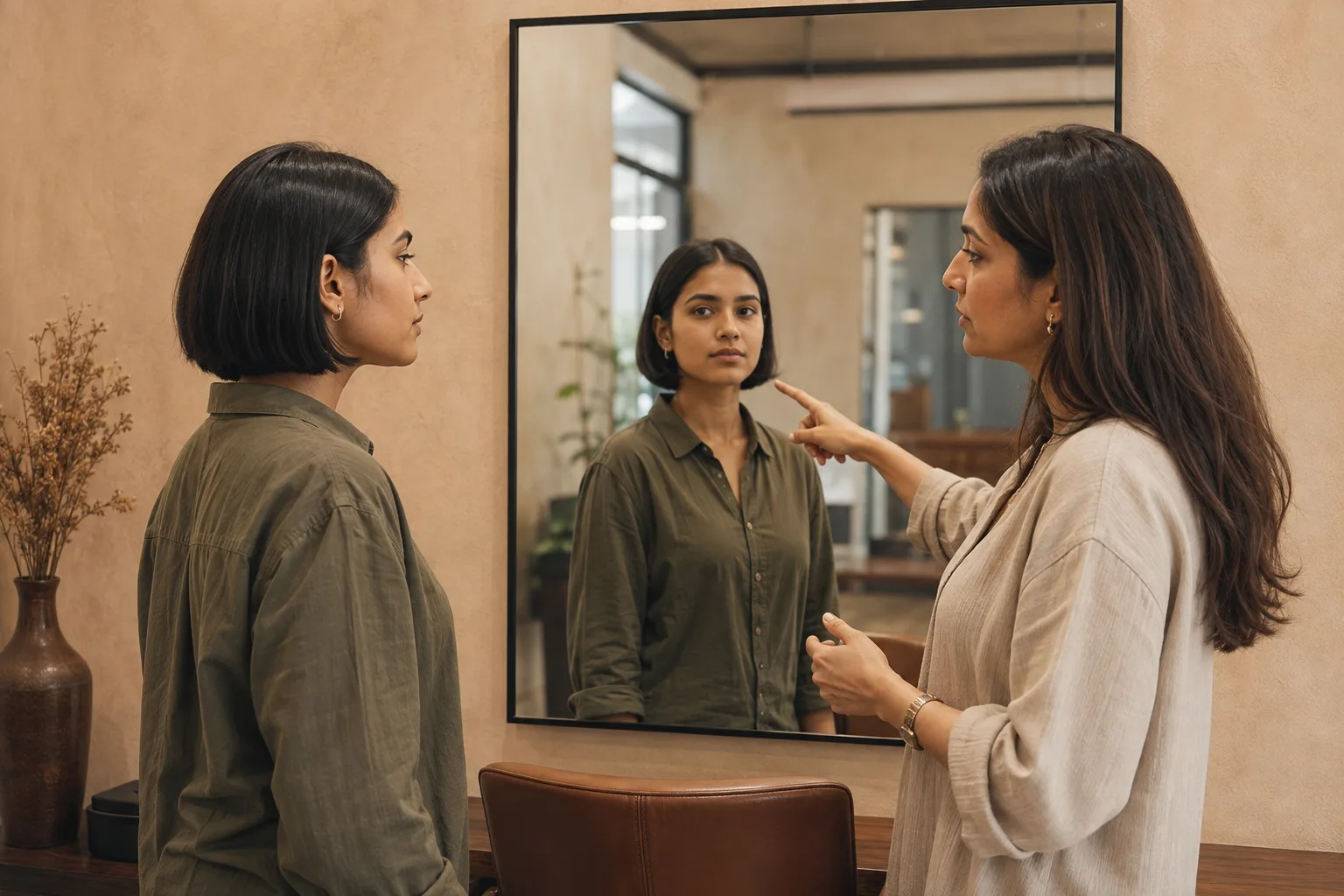
Bring the original photo, two clearly different shortlisted shapes, and one ordinary-day photo from the side or back. State the priority before the style name: ‘keep a continuous lower edge,’ ‘create height without widening the temples,’ or ‘retain enough front length to tuck.’ Add your maximum styling time, heat preference, usual part, wash rhythm, and any requirement involving glasses, headphones, helmet, collar, or tying. The stylist then has a visual direction plus the conditions that determine whether it is practical.
Ask where the real hair is densest and lightest, which lengths currently reach the perimeter, and what the shortest proposed sections may do without styling. Request a staged option if a major change would make the outcome uncertain. A qualified stylist can adapt length, graduation, layering, connection, and finish after examining the hair; Hair Muse cannot. The goal is not to reproduce a generated picture strand for strand. It is to agree on the most important proportion and protect a realistic fallback.
Review the real result without chasing permanent lift
After the salon finish is gone, photograph the cut in the same even light and wear it through at least two ordinary routines. Compare the chosen variables: endpoint, lower-edge strength, crown-to-side balance, movement, and the time needed to reach an acceptable finish. Do not mark the cut as a failure merely because it has less lift than the salon blowout. Ask whether the underlying outline is clearer and whether the routine is repeatable. Record one adjustment for the next appointment instead of changing every variable at once.
Fine strands are a physical characteristic, while sudden shedding, widening part lines, patchy loss, scalp symptoms, or unexpected breakage are separate concerns. A hairstyle preview and a haircut-planning guide cannot diagnose them. If you notice a new or worrying change, seek appropriate professional advice rather than trying to conceal or solve it through increasingly dramatic cuts. Visual tools are best used for preferences you can compare; health questions deserve evidence and an individual assessment.