
Haircut planning
How to plan a haircut around cowlicks and growth patterns
Turn the way your hair naturally lifts, splits, and changes direction into a useful salon plan.
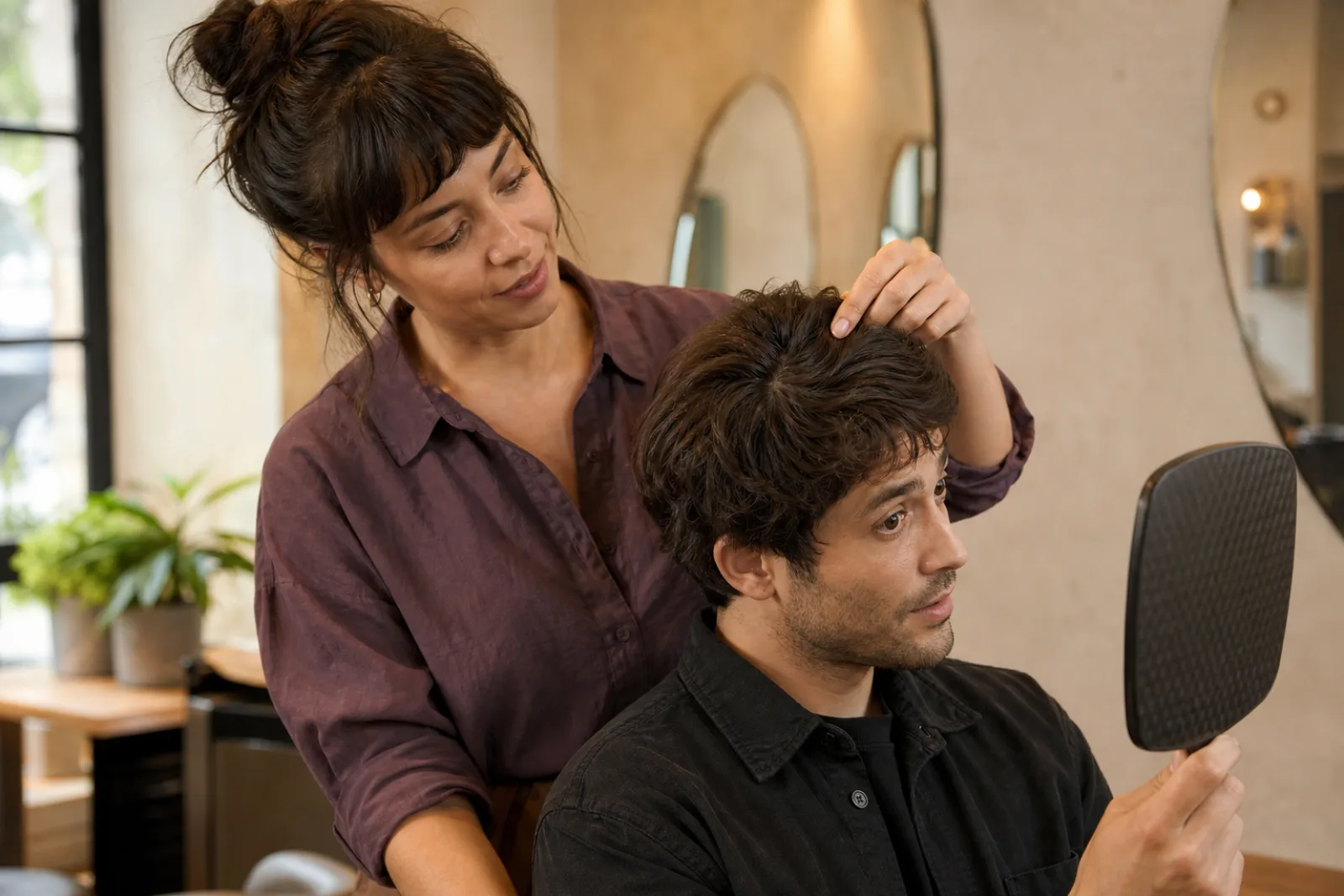
A section of hair that lifts, separates, or insists on moving in its own direction is not a styling failure. Cowlicks, crown whorls, hairline changes, and directional growth are part of the starting structure a haircut has to work with. Their effect can become more noticeable when length, weight, parting, or styling habits change, which is why a polished reference image alone is rarely enough to plan around them.
Hair Muse can help you compare visible ideas such as fringe depth, overall length, side volume, and a more open or covered hairline on your portrait. It cannot map the direction of every follicle or predict exactly where a freshly cut section will settle. The practical approach is to combine visual exploration with an honest record of your real hair, then let a stylist assess the growth pattern in person before deciding the technical details.
Map the areas that change direction
Start by identifying the places that repeatedly behave differently from the surrounding hair. Common examples include a spiral at the crown, one corner of the front hairline that lifts, a fringe that splits, a nape that grows toward one side, or temple hair that points forward. You do not need to diagnose or classify the pattern. Mark the location and describe what it does in ordinary language: rises when short, opens into a gap, crosses the part, lies flat, or turns outward.
Look at the whole head rather than focusing only on the most obvious spot. A preferred part may be supported on one side and resisted on the other. Two crown patterns may distribute volume differently from a single central swirl. Hair near the ears may change direction after being tucked. This map gives the consultation a practical starting point and helps prevent one visible concern from hiding another that matters to the finished shape.
- Front hairline and both corners of the forehead
- Usual part and the direction hair crosses it
- Crown, upper back, nape, temples, and around the ears
- Sections that lift, split, flatten, or reverse direction
Photograph the pattern before styling it away
Take clear photos when the hair is clean, fully dry, and arranged as you normally wear it. Capture the front, both sides, back, crown, and part in soft neutral light. If the area is hard to photograph, ask someone to help rather than relying on a distorted close-up. Include enough surrounding hair to show how the section connects to the overall silhouette. Avoid filters, portrait blur, and strong overhead lighting that can hide direction or exaggerate visible scalp.
Add a second set after your usual styling, then label the difference. Perhaps water alone redirects the front, a small amount of product keeps the crown together, or heat is needed to hold a fringe across the hairline. Also photograph what happens after sleep, exercise, a hat, or a normal workday if those conditions reveal the pattern again. The purpose is not to present perfect hair; it is to show which result is natural, which is manageable, and which requires effort you may not want to repeat.
Bring both the uncorrected pattern and your normal solution. The contrast shows what the haircut must support.
Separate the shape you want from the way it is styled
When you collect references, name the structural idea first. You might like the exposed forehead, compact outline, longer front, soft side movement, or volume placed away from the crown. Then list the finish details that may depend on brushing, heat, product, or a carefully chosen camera angle. A smooth fringe crossing a strong front lift and an evenly rounded crown are visual outcomes, not proof that the pictured haircut behaves that way without styling.
This distinction keeps the goal useful even when your stylist recommends a different route. The intention behind a straight-across fringe might become a softer split fringe, or the clean shape of a short crop might require a little more length over one growth area. An adaptation can preserve the proportion or mood you liked without pretending that natural direction does not exist. Ask for the reason behind the change so you can decide whether the tradeoff still suits you.
Use previews to compare visible directions, not hair mechanics
Choose one sharp, front-facing source photo with the full head and hairline visible. In Hair Muse, compare a small set of targeted alternatives using the same source. For a front pattern, try an open hairline, a side-swept direction, and one fringe idea. For a crown concern, compare broader differences in length, layering, and volume placement. Keep everything else as stable as possible so you can identify which visual change you actually prefer.
Review each result critically. A generated preview may smooth over a cowlick, invent a new part, change density, or place strands against their real direction. Reject images that alter your face or starting structure enough to confuse the choice. For the useful ones, annotate the concept rather than the simulated detail: ‘I like this much forehead,’ ‘keep fullness here,’ or ‘this side direction feels balanced.’ Those notes turn an imperfect preview into a clear conversation tool.
A preview can show whether you like a silhouette. It cannot prove that a growth pattern will hold the pictured placement.


Discuss length as a range, not a magic number
Growth patterns often become more or less visible as hair moves through different lengths, but there is no universal point at which a cowlick disappears. Very short hair may follow its natural direction clearly; additional length may add enough weight to change the result, or it may create a larger separation before it becomes manageable. Texture, density, strand thickness, styling, and the exact placement of the pattern all influence the outcome.
Ask the stylist to show the relevant section and explain the length range they recommend for your chosen shape. If you are considering a major change, discuss what would happen if that area stayed slightly longer or became slightly shorter than the reference. For a fringe, clarify where it would sit when dry and how it would separate without styling. For a crown or nape, ask how the perimeter and layers will connect to the direction already present.
Test the part, fringe, and short perimeter separately
A parting decision can change the balance of an entire haircut. Photograph your usual part, a nearby alternative, and the point where the hair naturally separates after washing. You do not have to follow the natural split, but moving far away from it may add daily work. If you alternate sides, say so before the cut. A shape designed around one fixed part can fall differently when reversed, particularly near the front and crown.
Treat fringe and very short edges as separate commitments because small length changes can affect how strongly direction shows. Before choosing them, describe your minimum acceptable routine: re-wetting, brushing, applying product, using a dryer, or doing nothing. Ask what the section is likely to do on an unstylized morning and whether it can still be pinned, swept aside, or blended into the rest of the cut. The answer should be based on an in-person look at your hair, not a generic rule.
Plan one realistic styling response
Decide how much cooperation you are willing to ask from the hair. Some people are comfortable re-wetting a front section and directing it for a minute; others want the natural movement to become part of the design. Neither preference is more correct. Be specific about tools, products, time, and frequency. A stylist can then explain whether the proposed result fits that limit or depends on a routine you are unlikely to maintain.
Request a simple demonstration for the exact section that concerns you, and record the steps if the salon permits it. Ask what to do immediately after washing, what to do once the hair is dry, and what the fallback is on a rushed day. Product and technique can influence direction, but they should not be presented as a permanent change to the growth pattern. If the plan only works under ideal styling, decide openly whether the visual result is worth that upkeep.
- No-style version for an ordinary morning
- Quick reset for the front, crown, or nape
- Polished option for days when you choose more effort
- Fallback part or pinned style when the section will not cooperate
Build a salon brief with a preferred option and fallback
Bring your unedited growth-pattern photos, two or three focused previews, and a short note about your routine. Point out the natural direction before the hair is washed or heavily styled. For each image, name the feature you want to preserve and the detail you are willing to adapt. A useful request might be: ‘I like this open front and compact side shape, but I need the lifting corner to work without daily heat.’ That is clearer than asking for an exact copy.
Finish the consultation with two plans. The preferred option is the shape you want if the stylist believes it can work with your pattern and routine. The fallback keeps the most important visual goal while allowing a different fringe, part, length, or perimeter. Confirm how the first wash at home should be handled and when the shape should be reassessed. A good plan does not erase natural growth; it gives that growth a deliberate place in the haircut.