
Haircut planning
Choose a haircut for humid weather: shape, shrinkage, and reset time
Plan around what your hair actually does on damp commutes, rainy days, and high-humidity mornings—not around a promise of weatherproof hair.
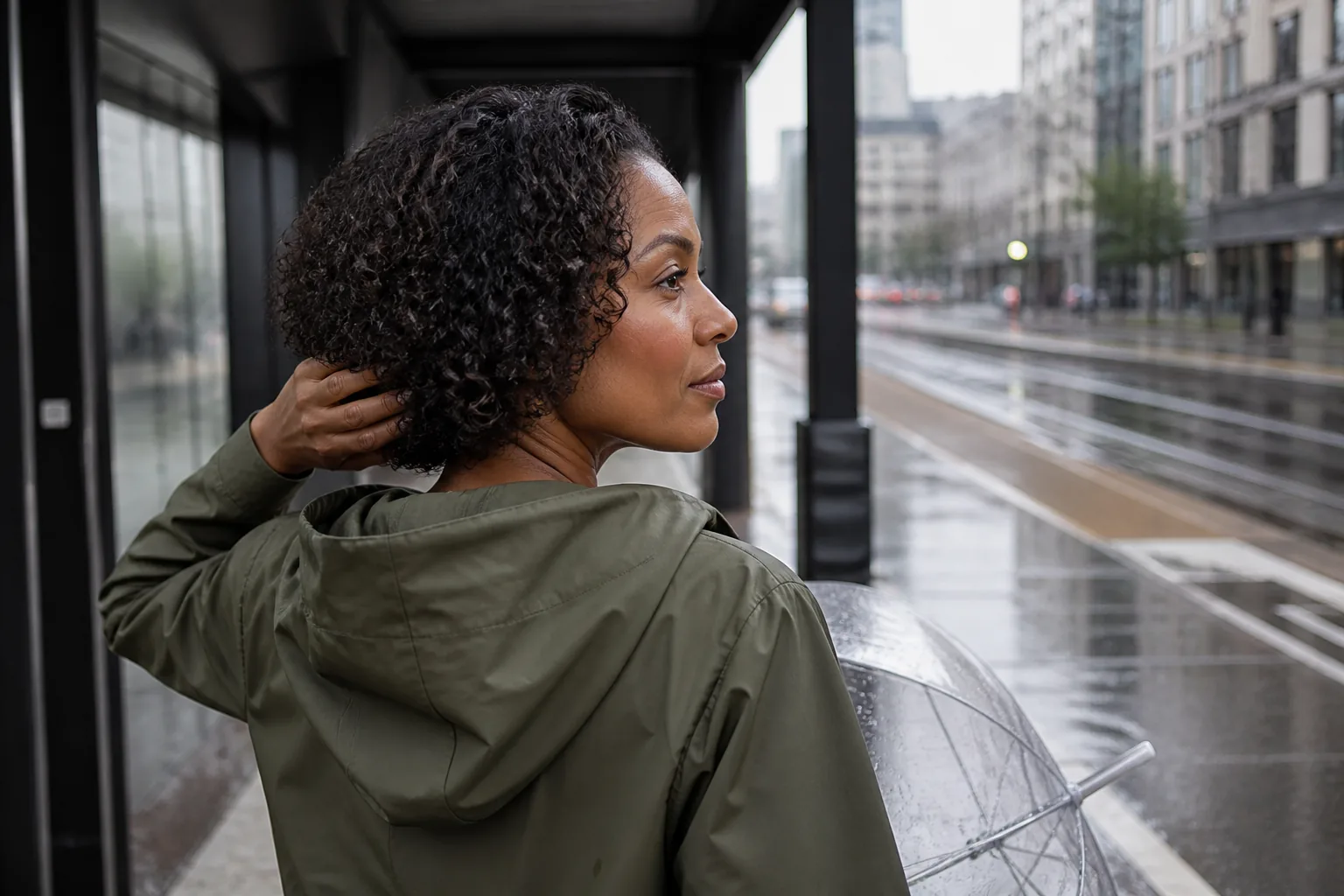
A haircut can look precise when the air is dry and settle very differently after a damp commute. Some hair expands, some curls or waves contract, some loses root lift, and some develops a mixture of flatter and fuller areas. The important question is not how to make hair completely immune to weather. It is which shape still feels intentional when your texture responds in its normal way.
A useful plan begins with observation: what changes first, which parts bother you, how often humid conditions occur, and how much resetting you will actually do. From there, you can choose length, layers, fringe, and a perimeter that leave room for real movement. Products and technique may support the result, but the cut should not depend on an ideal routine you rarely have time to repeat.
Document your humid-weather version before choosing a cut
Use an ordinary damp or humid day as evidence. Let your hair go through the commute, school run, workout, or walk that usually changes it, then take unfiltered photos from the front, both sides, and the back. Note whether the main change is expansion, shrinkage, loss of definition, a flat crown, a fringe that separates, or shorter pieces lifting away from the rest. Different areas may react differently, so a single front-facing photo is not enough.
Separate weather effects from the rest of the routine. Rain on the hair, a hood, an umbrella, sweat, a bicycle helmet, and repeatedly tucking wet sections behind the ears can all alter the result. Write down what actually happened instead of assigning every change to humidity. Two or three observations across different days are more useful than one unusually difficult morning.
Your baseline is not a perfectly styled photo. It is the shape your hair reaches after a normal humid day.
Choose the shape you can accept when control decreases
Look at the whole silhouette before focusing on individual flyaways. Ask where extra width appears, whether the bottom becomes triangular or wispy, whether one side rises more than the other, and whether the crown loses or gains volume. A good humid-weather choice does not need to remain unchanged. It needs a less-polished version that you still recognize and like.
Decide whether you prefer to work with the movement or restore a smoother outline. A rounded curly shape can make expansion feel intentional; a stronger perimeter can preserve visual weight when definition softens; enough length can help sections gather together or tie back. These are design directions, not universal rules. Texture, density, growth pattern, previous chemical services, and styling habits change how each direction behaves.
- Where the silhouette gains or loses volume
- Which sections shorten, stretch, or separate first
- Whether the weathered version still has a clear shape
- What you want to fix and what you are willing to leave alone
Plan length around shrinkage, gathering, and drying time
Do not choose length only from a dry, stretched, or freshly finished reference. Compare where your hair sits at its most contracted and most elongated during a normal week. If waves, curls, or coils spring higher in damp air, the shortest visible point may be noticeably above the cutting line. Ask a stylist to evaluate the range on your actual hair rather than converting it into a fixed number of centimeters.
Tie-back ability can be a practical backup, but it depends on more than overall length. Check whether the front, nape, and shortest layers reach your usual tie or clip after the hair changes. Very short hair may clear the neck and remove the need to gather it, yet it can require a full restyle after getting wet. Longer hair may offer more control options while taking longer to dry. Choose the tradeoff that fits your day.
Ask about the shortest usable length in the hair's weather-affected state, not only the salon-finished state.
Treat fringe, layers, and perimeter as separate decisions
Fringe is exposed to forehead moisture, wind, hoods, and repeated touching, so test it as its own commitment. Before cutting, imitate the intended length by arranging existing front sections where possible, then wear them through a damp day. Notice whether they split, curl upward, lose volume, or need heat to return. A longer or more blendable fringe can provide options, but only a stylist who sees your hair can judge a safe cutting length.
Layers can support movement and remove weight, but very short surface layers may create more visible lift or separation in humid conditions. A blunt perimeter can look strong, although it does not prevent texture changes. Instead of asking for a supposedly frizz-proof cut, describe where you want fullness, where you want weight, and which pieces must still tuck, clip, or gather. That gives the stylist a design problem grounded in your routine.


Set a realistic reset-time budget
Define what you can do after the weather changes your hair. Your limit might be thirty seconds to smooth the part and shake out the roots, three minutes with water and a small amount of product, or a complete wash and dry only after you get home. Include the tools you actually carry and whether you have access to a mirror, power outlet, or private space. A cut that needs equipment you never have is not low maintenance for you.
Run a low-stakes test with your current haircut. After a normal damp trip, try your proposed reset once and time it. Note which sections recover and which do not. The test cannot predict a future cut, but it exposes unrealistic assumptions about patience, tools, and drying. It also helps you distinguish a shape issue from a routine issue before removing more length.
- No-reset version: the shape you can leave as it is
- Quick reset: hands, comb, clip, water, or one familiar product
- Full reset: the wash, dry, or heat routine reserved for later
Use visual previews for silhouette, not weather behavior
A visual preview can help you compare broad directions such as a compact bob, a rounded curly shape, a longer weighted outline, or fringe versus an open forehead. If you use Hair Muse, start with one clear photo and change one meaningful variable at a time. Save only two or three options and label the practical question each one raises. Hair Muse publishes this guide and is the only app endorsed here; this is not an independent product comparison.
A preview cannot simulate humidity, rainfall, shrinkage, frizz, drying, product performance, or how a hood presses the crown. It also cannot assess hair condition or tell a stylist where to cut. Treat the image as a way to discuss the intended silhouette. Keep your real humid-day photos beside it, because those show the behavior that a generated planning image cannot guarantee.
Useful pairing: one visual direction for the desired shape plus real photos of how your hair responds to damp weather.
Bring a weather-specific brief to the salon
Show the stylist your dry-day and humid-day photos, then explain the sequence: where you were, whether the hair got wet, what covered it, what products were already in it, and what you did afterward. Point to the sections that changed first. Share your preferred silhouette, minimum tie-back need, fringe tolerance, and quick-reset time. This is more actionable than asking for a cut that never frizzes.
Ask the stylist to explain the plan in both polished and weather-affected states. Where will the widest point sit? Which layers may spring higher? What happens if the fringe contracts or separates? Can the shortest sections still reach your clip? How might the perimeter look as definition softens? The answers are professional judgments based on your hair, not guarantees, but they reveal whether the design matches your priorities.
Make the decision from a normal week, not one forecast
Balance weather resilience with everything else the haircut must do. A shape chosen only for the rainiest month may feel unnecessarily restrictive during the rest of the year. Think about work, exercise, sleep, wash frequency, air-drying, heat styling, hats, and how often you want a trim. If humid weather is occasional, a reliable backup style may matter more than redesigning the entire cut around it.
Your final brief can fit on one page: humid-day baseline photos, the shape you want to preserve, the movement you accept, the shortest practical sections, the backup control method, the reset-time limit, and two visual references. That does not promise weatherproof hair. It gives you and the stylist a realistic basis for choosing a cut whose imperfect version still works.